
Colorado Cottage Food Law: A 2026 Guide for Home Bakers and Makers
By Hobby Stall Team · June 13, 2026 · 5 min read
Colorado's cottage food law is more flexible than most on what you can sell, including pickled vegetables and a wide range of confections that other states prohibit. The tradeoff is a per-product revenue cap today, a scheduled shift to a higher overall cap under the "Tamale Act" in 2027, and a required food safety training course before you start. If you understand how the current cap works and plan ahead for the 2027 change, it's a workable framework for a real home food business.
The per-product cap (through 2026)
Most states cap total annual revenue from a cottage food operation. Colorado does something different under its current rules: it caps revenue per product at $10,000 annually, under the Colorado Cottage Foods Act (SB 12-048). The per-product model is the single most confusing part of the law for new sellers, so it's worth spending a moment on it.
Different flavors count as different products. Blueberry jam and strawberry jam are two separate products, each with its own $10,000 limit. If you have six flavors, your theoretical ceiling for jam alone is $60,000. In practice, most cottage food sellers don't hit the cap on most products. But you need to track sales by individual product, not just total revenue.
When a specific product hits $10,000 for the calendar year, stop selling that product. You can keep selling everything else. Caps reset on January 1.
Keep a simple ledger: date, product name, quantity, price per unit. A spreadsheet works fine. You want to be able to show per-product totals at a glance without having to reconstruct sales history if a question ever comes up.
For current figures, check with the Colorado Department of Public Health and Environment, which administers the Cottage Foods Act.
The 2027 "Tamale Act" change
House Bill 26-1033, known as the "Tamale Act," was signed into law in 2026. It replaces the $10,000 per-product cap with a single inflation-indexed cap of $150,000 per year, adds a CDPHE registration requirement, and for the first time lets producers sell certain time- and temperature-controlled foods like tamales under strict handling rules. The effective date is January 1, 2027. Until then, the $10,000 per-product limit described above stays in force. Once the act takes effect, CDPHE will publish guidance on how to register and how the new CPI-adjusted cap works in practice.
Registration and training requirements
Colorado doesn't inspect your kitchen, but it does require two things before you sell: business registration and a food safety training certificate.
Business registration is free through the Colorado Secretary of State at mybiz.colorado.gov. Choose your business structure (sole proprietorship is the simplest option for most home producers), register your business name, and get your registration on file. You'll reference this registration on your product labels.
Sales tax registration is separate but also free, through the Colorado Department of Revenue at colorado.gov/revenueonline. Cottage food sales are subject to Colorado sales tax. You'll collect tax at the point of sale and file quarterly or annual returns depending on your volume.
Food safety training must be completed before you start selling. Colorado State University Extension offers a course designed specifically for cottage food producers, available through extension.colostate.edu. Some county health departments also offer approved training. The course covers personal hygiene, cross-contamination, temperature control, and Colorado-specific cottage food rules. Save your certificate; you may need it if your operation is ever questioned.
What you can sell
Colorado's allowed list is one of the broader ones in the country, particularly for savory and preserved products.
Allowed:
- Breads, rolls, biscuits, muffins, tortillas, and other unleavened breads
- Cookies, cakes (without cream filling), brownies, and bars
- Fruit pies (high-acid fillings only)
- Pastries without cream or custard
- Jams, jellies, fruit butters, and preserves
- Pickled vegetables (pH must be 4.6 or below, with documentation)
- Dried fruit and dehydrated vegetables
- Granola, trail mix, roasted nuts, nut butters, and seeds
- Candy, fudge, chocolate-covered items, caramel corn, brittles
- Honey, dried herbs, spice mixes, and flavored salts
- Crackers and baking mixes
- Fruit empanadas (explicitly listed in Colorado law)
Not allowed:
- Meat, poultry, or seafood products
- Cream cheese frosting, custards, or puddings
- Ice cream or yogurt
- Fresh-cut produce
- Fermented foods without proper pH documentation
- Cannabis-infused products
- Alcohol-infused products (except where alcohol fully cooks off)
The pickle permission is real, but don't skip the pH step. Improperly acidified pickles can harbor botulism. Use a calibrated pH meter, test every batch, and keep the records. If you're new to pickling, Colorado State University Extension's food preservation resources are a good starting point.
Labeling requirements
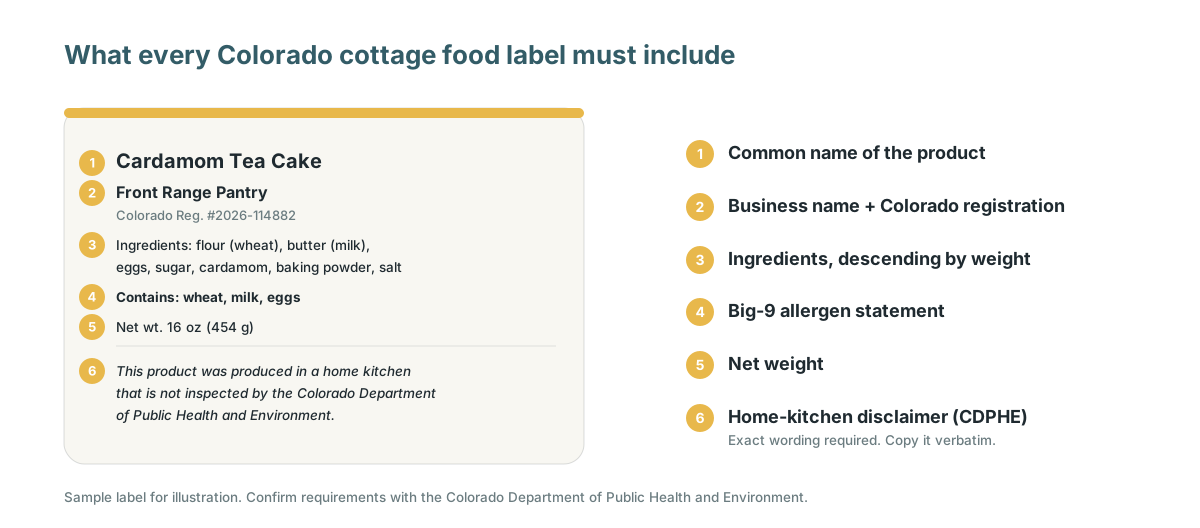
Every product needs a label with all required information before it leaves your kitchen. Colorado's required label elements under the Cottage Foods Act are:
- Product name (common name, like "Dill Pickles" or "Sourdough Bread")
- Your business name and Colorado business registration details
- Ingredients in descending order by weight, with sub-ingredients spelled out
- Allergen statements for the Big 9: milk, eggs, fish, shellfish, tree nuts, peanuts, wheat, soybeans, and sesame
- Net weight
- The required disclaimer: "This product was produced in a home kitchen that is not inspected by the Colorado Department of Public Health and Environment."
A clear, printed label beats a handwritten one for professionalism and legibility. Many producers order rolls of custom labels from online printers once they've finalized their recipes.
Where you can sell
Colorado allows a range of direct-to-consumer sales channels:
- From your home: Buyer pickup at your address
- Farmers markets and roadside stands
- Community events, holiday markets, festivals, and craft fairs
- Online within Colorado: Your website, social media, and in-state platforms
- Limited wholesale: Recent regulatory updates may allow some wholesale sales; verify current rules directly with CDPHE before pursuing retailer accounts
Interstate shipping isn't permitted. Colorado cottage food law covers in-state direct sales only.
Scheduling preorders and batch windows
A per-product cap creates a natural incentive to diversify. Many Colorado cottage food producers run 5 to 10 products at a time, rotating what's available based on season and what's near its cap. Managing preorders for multiple products, tracking who claimed what, and coordinating pickup windows is the kind of workflow that turns into a second job if you're doing it over text and email. Hobby Stall lets you schedule drop windows for each batch, let buyers claim specific items, and keep everything organized in one place. Payment goes directly to you, no commission. See how it works or start your shop.
This post is general information, not legal advice. Colorado cottage food law is subject to change through new legislation. Verify current requirements with the Colorado Department of Public Health and Environment at cdphe.colorado.gov before starting your cottage food operation.
Frequently asked questions
- How does Colorado's per-product revenue cap work?
- Colorado caps gross annual revenue at $10,000 per cottage food product, not per operation. A different flavor counts as a different product. So if you sell three flavors of jam, each can earn up to $10,000 before you hit the limit for that item. Once a specific product hits $10,000 for the year, you stop selling it until January 1. Verify current figures with the Colorado Department of Public Health and Environment.
- Do I need a permit to sell cottage food in Colorado?
- No permit or inspection is required from the Colorado Department of Public Health and Environment. You do need to register your business with the Colorado Secretary of State at mybiz.colorado.gov (free) and register for a sales tax account with the Colorado Department of Revenue (also free). Completion of a Colorado-approved food safety training course is required before you start selling.
- What food safety training does Colorado require?
- Colorado requires completion of an approved food safety training course before operating a cottage food business. Colorado State University Extension offers a course designed specifically for cottage food producers. Some county health departments also offer approved training. Check extension.colostate.edu for current course availability and locations.
- Can I sell pickled vegetables under Colorado cottage food law?
- Yes, pickled vegetables are explicitly allowed in Colorado, which sets it apart from most other states. However, properly acidified pickled products require pH testing to verify food safety. You'll need a calibrated pH meter or reliable test strips, and you should keep records of your pH readings. Products must test at 4.6 pH or below to be considered safe.
- What must appear on a Colorado cottage food label?
- Labels must include the product name, your business name and registration information, a complete ingredient list in descending order by weight, allergen statements, net weight, and the disclaimer: 'This product was produced in a home kitchen that is not inspected by the Colorado Department of Public Health and Environment.' The label format and required elements are outlined under Colorado's Cottage Foods Act.
- Can I sell Colorado cottage food online?
- Yes, online sales are allowed within Colorado. You can sell through your own website, social media, or platforms like Etsy to Colorado buyers. Most producers focus on local pickup or in-state delivery to stay clearly within the direct sales requirement. Interstate shipping is not permitted under Colorado cottage food law.
Keep reading
- Florida Cottage Food Law: A 2026 Guide for Home Bakers and Makers
Florida's cottage food law requires zero permits, zero inspections, and zero training. Learn the $250K sales cap, allowed foods, labeling rules, and where you can sell under Florida Statute § 500.80 as of June 2026.
- Michigan Cottage Food Law: A 2026 Guide for Home Bakers and Makers
Michigan's cottage food law was updated in 2026 to raise the annual sales cap to $50,000 (or $75,000 for high-value products). Learn the allowed foods, labeling requirements, and sales rules from the Michigan Department of Agriculture and Rural Development.
- How to Price Home-Roasted Coffee (With Real-World Math Examples)
A practical pricing guide for home coffee roasters and micro-roasteries selling at farmers markets, local pickup, or online drops.