Big Cartel vs Shopify: Cost and Caps Compared
By Hobby Stall Team · June 13, 2026 · Updated August 6, 2026 · 8 min read
Big Cartel and Shopify sit at opposite ends of the same shelf. One is a deliberately small storefront that costs $15 a month and caps how many products you can list. The other is a full commerce platform that starts at $39 a month before a single card gets swiped. If you make 20 things at a time in a home kitchen or a garage studio, that gap usually settles the question before you open a feature chart.
Big Cartel vs Shopify: the short answer
Big Cartel is cheaper. Shopify does more. For most small-batch makers that's the whole comparison, and the only live question is whether you'll hit Big Cartel's product ceiling.
| Big Cartel Gold | Big Cartel Platinum | Big Cartel Diamond | Shopify Basic | |
|---|---|---|---|---|
| Monthly cost | $0 | $15/mo ($144/yr) | $30/mo ($288/yr) | $39/mo ($29/mo billed yearly) |
| Product cap | 5 | 50 | 500 | Unlimited |
| Platform cut of sales | $0 | $0 | $0 | $0 on Shopify Payments, 2% on any other processor |
| Card processing | Stripe 2.9% + $0.30 or PayPal 3.49% + $0.49 | Same | Same | 2.9% + $0.30 (Shopify Payments) |
| Inventory tracking | ❌ | ✅ | ✅ | ✅ |
| Scheduled drops | ❌ | ❌ | ✅ | ❌ (app required) |
| Intro offer | Free, no card required | 7 days free | None listed | 3 days free, then $1/mo for 3 months |
Verified August 2026 against the Big Cartel pricing page, Big Cartel's plan and feature comparison, and Shopify's pricing page.
Choose Big Cartel if you keep fewer than 50 things listed, ship most of your orders, and want a monthly bill small enough to forget about. Platinum at $15 covers a custom domain, inventory tracking, discount codes, and discounted shipping labels. Big Cartel takes nothing off the top of your sales, and its processing fees article says so directly: fees come from Stripe or PayPal, and Big Cartel never holds your money or deducts from it.
Choose Shopify if you can picture yourself past 500 products, need variant-level inventory across locations, or want to sell through more than one channel. Shopify Basic sells unlimited products and has the deeper toolset by a wide margin. What the $39 buys you is headroom. If your entire operation is 40 loaves on a Friday, that headroom is expensive shelf space.
One asymmetry to know before you pick. Shopify charges 2% on every order when you use any payment processor other than Shopify Payments. Big Cartel has no equivalent surcharge on any plan. If you're attached to your own processor, Shopify's real price is meaningfully higher than the sticker.
What the fees actually cost on $2,000 a month
Assume $2,000 in monthly sales across 50 orders averaging $40. Card processing at Stripe's standard U.S. rate of 2.9% plus $0.30 per order comes to about $73.
Big Cartel Platinum: $15 plan plus roughly $73 to Stripe, so about $88 a month.
Shopify Basic: $39 plan plus roughly $73 to Shopify Payments, so about $112 a month. Swap in a third-party processor and the 2% surcharge adds another $40 or so, pushing you past $150.
Hobby Stall Starter: a flat $12 a month in the same scenario — 0% commission and no processing fee, since buyers pay you directly by Venmo or Cash App.
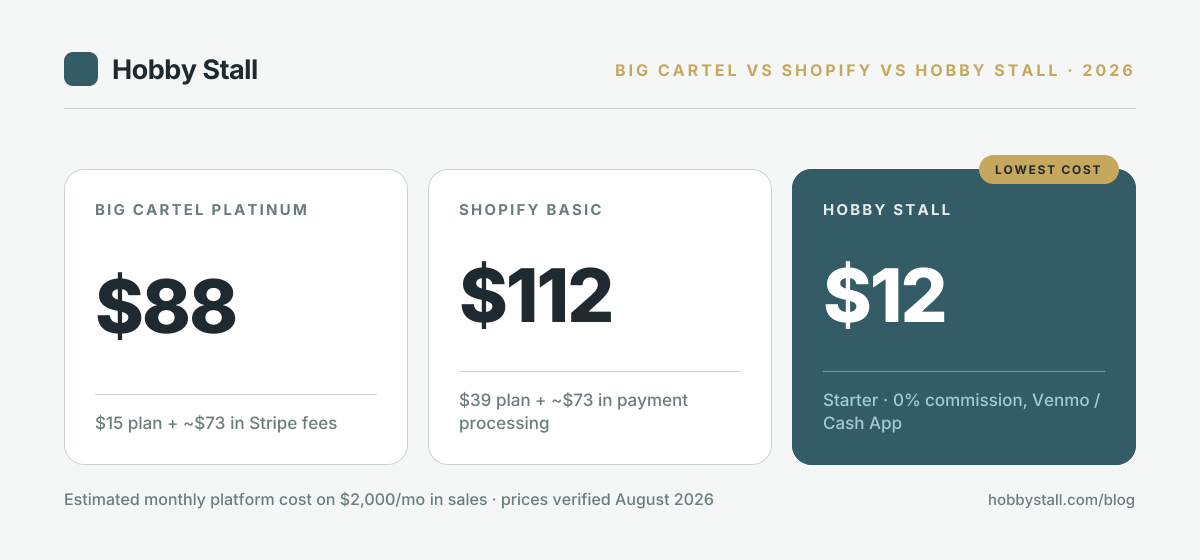
Twenty-four dollars a month is real money over a year, but it isn't the deciding factor. The product cap is. Fifty listings on Platinum is a hard wall, and stepping up to Diamond at $30 a month costs more than Shopify Basic billed yearly at $29. That's the point where "Big Cartel is the cheap one" stops being true.
The seller neither one is built for
A third shape of business exists that both platforms handle awkwardly. No shipping at all. A batch that sells out in an hour. Buyers who hand you cash or send a Venmo when they collect. Shopify's shipping and checkout machinery is dead weight for that seller, and Big Cartel's storefront assumes a standing catalog somebody browses on a Tuesday afternoon.
Hobby Stall was built for that narrower case, so read the rest of this as the honest scope of a third option rather than a bigger version of the first two. Flat subscription, 0% commission, buyers paying you directly through Venmo or Cash App, and a storefront organized around timed drops and pickup windows. No card checkout. A smaller catalog cap than Big Cartel's.
| Big Cartel Gold | Big Cartel Platinum | Big Cartel Diamond | Shopify Basic | Hobby Stall Starter | Hobby Stall Growth | |
|---|---|---|---|---|---|---|
| Monthly cost | $0 | $15 ($144/yr) | $30 ($288/yr) | $39 ($29/mo yearly) | $12 ($108/yr) | $24 ($228/yr) |
| Commission on sales | $0 | $0 | $0 | $0 (2% off Shopify Payments) | $0 | $0 |
| How buyers pay | Stripe / PayPal | Stripe / PayPal | Stripe / PayPal | Shopify Payments | Venmo / Cash App, direct to you | Venmo / Cash App, direct to you |
| Product cap | 5 | 50 | 500 | Unlimited | 10 | 50 |
| Scheduled drops | ❌ | ❌ | ✅ | ❌ | ✅ (1 per month) | ✅ (unlimited) |
| Local pickup built in | ❌ | ❌ | ❌ | ✅ | ✅ | ✅ |
Hobby Stall plan details live on the pricing page. A card is required at signup and the first month is $1 on a monthly plan.
Local pickup
Shopify enables pickup in store per location in the admin, with prep times and buyer-facing instructions, and the buyer selects it at the cart. It assumes a merchant with a fixed address and predictable hours. Shopify's pricing page files more advanced in-store pickup and flexible delivery under the paid POS Pro add-on rather than Basic, so check that the exact behavior you want is covered.
Big Cartel has no native pickup feature. The common workaround is a $0 shipping option named "local pickup" plus a line in the product description telling nearby buyers to message you. Functional. Also entirely manual.
Hobby Stall puts pickup inside the claim flow. You set up pickup options with a label, a meeting point, and time windows, and the buyer chooses one when they claim. Unpaid claims expire after 48 hours and that inventory goes back on the shelf on its own, which is the part that matters when somebody claims four cinnamon rolls on Wednesday and never pays.
Drop scheduling and batch releases
Big Cartel Diamond at $30 a month includes Scheduled Drops. You pick a date and time and products flip from hidden or coming soon to active without you sitting at a laptop. Read the help article before you plan a launch around it: the notification emails go to you, 24 hours ahead and again at launch. Your customers get nothing. There's no buyer-facing countdown and no claim window.
Shopify has no native drop feature. You can future-date a product's publication and cap quantities with inventory tracking, which covers the mechanics. A countdown, a claim window, or a coordinated batch release means a third-party app and another monthly line item.
Hobby Stall drops have a name, an open and close window, an optional password on Growth, and product groups you drag into order. Buyers see a live countdown before open and a "coming up" list for scheduled future drops. Starter allows one drop per calendar month, which is enough for a monthly kiln release and not enough for weekly bread. Growth removes the limit and allows concurrent drops.
Catalog and product management
Shopify has the deepest catalog here and it isn't close. Unlimited products, variants, collections, and an app for anything left over. For a maker rotating 15 items, most of that sits unused.
Big Cartel caps at 5 products on Gold, 50 on Platinum, and 500 on Diamond, with 1, 5, and 25 images per product respectively. Size and color variants work on every plan including free Gold. Inventory tracking starts at Platinum. The ceiling is the thing to plan around, not the feature list.
Hobby Stall caps at 10 products on Starter and 50 on Growth, with 1 image per product on Starter and 3 on Growth. That's a deliberate constraint rather than a gap waiting to be filled. The catalog exists to feed drops, and revenue tracking, CSV export, and the full buyer CRM are Growth-tier features.
Storefront and branding
Shopify wins customization outright: dozens of themes, a real visual editor, and CSS access on Basic. Big Cartel's templates are clean and limited, which some makers find restful and others find confining. Hobby Stall's Growth tier allows a custom logo, colors, and font pairing on a storefront laid out to make a drop look like an event instead of a shelf, with a shop URL like hobbystall.com/your-shop-name and an auto-generated social preview card.
Who each one is actually for
Big Cartel suits artists and makers who want a permanent, cheap storefront, ship most of what they sell, and won't cross the product cap. The free Gold plan is a legitimate way to find out whether anyone buys before you spend a dollar.
Shopify Basic earns its $39 once you need variant inventory, multi-channel selling, or a path toward a staffed operation. It's overbuilt for a cottage food seller doing pickup only, and you'll notice that every month on the invoice.
Hobby Stall suits the seller running scheduled batch releases and handing bags to people in a parking lot, taking payment on Venmo or Cash App, who doesn't want a cut taken and doesn't need card checkout or shipping logistics.
Prices and features move. Verify current rates on the Big Cartel pricing page and Shopify's pricing page before deciding. Every figure above was checked against those pages and Big Cartel's help center in August 2026, with one gap: Shopify's help center articles documenting pickup setup block automated checks, so the pickup details here come from Shopify's public pricing page rather than a linkable help doc. If the drop-and-pickup pattern is what you actually run, start a shop and see whether it fits.
Frequently asked questions
- Is Big Cartel cheaper than Shopify?
- Yes, at every plan level. Big Cartel's Gold plan is free for up to 5 products, Platinum is $15 per month for up to 50, and Diamond is $30 per month for up to 500. Shopify Basic is $39 per month, or $29 per month billed yearly. Neither one takes a commission on your sales, but Shopify adds a 2% transaction fee if you use a payment processor other than Shopify Payments. Prices verified August 2026.
- Does Big Cartel charge transaction fees?
- No. Big Cartel's help center states that it does not charge transaction fees on your orders and does not hold your funds. You pay your plan cost plus whatever your processor charges. For U.S. accounts as of August 2026 that is roughly 2.9% plus $0.30 through Stripe, or 3.49% plus $0.49 through PayPal.
- Does Shopify charge transaction fees if you use a third-party payment processor?
- Yes. Shopify Basic charges a 2% transaction fee on every order when you use a payment processor other than Shopify Payments. On Shopify Payments there is no extra transaction fee beyond the card rate, which is 2.9% plus 30 cents for standard online card payments on Basic as of August 2026.
- How many products can I list on Big Cartel versus Shopify?
- Big Cartel caps products by plan: 5 on the free Gold plan, 50 on Platinum at $15 per month, and 500 on Diamond at $30 per month. Shopify Basic sells unlimited products. If you expect to cross 500 listings, Big Cartel will eventually force the move.
- Can I run drop-style batch releases on Big Cartel?
- Big Cartel's Diamond plan includes Scheduled Drops, which flips products from hidden or coming soon to active at a date and time you set. The notification emails it sends go to you as the seller, 24 hours ahead and again at launch, not to your customers. It does not add a buyer-facing countdown, a claim window, or automatic release of unpaid orders.
- Does Shopify support local pickup?
- Yes. Shopify supports pickup in store as a delivery method you enable per location in the admin, with prep times and buyer instructions, and buyers select it at the cart. Shopify's pricing page lists more advanced in-store pickup and flexible delivery options under the paid POS Pro add-on rather than the Basic plan, so confirm the specific behavior you need is covered before you commit.
- Which platform costs least for a cottage food seller doing $1,500 per month?
- At $1,500 a month across roughly 38 orders, Big Cartel Platinum runs about $70 (a $15 plan plus about $55 in Stripe fees) and Shopify Basic runs about $94 ($39 plus the same processing). Hobby Stall Starter is $12 with no processing at all, because buyers pay you directly on Venmo or Cash App. The tradeoff is that Hobby Stall has no card checkout and Starter caps you at 10 products.
Keep reading
- Square Online vs Hobby Stall for Cottage Food Sellers
Square Online and Hobby Stall both support local pickup and preorders, but they're built for different sellers. This comparison covers pricing, fees, local pickup setup, and which platform fits cottage food and home-based food businesses in 2026.
- The Best Etsy Alternatives for Local Sellers (Drops, Preorders, and Pickup)
Honest picks for makers who sell to their own city: drop-based shops, preorder tools, and local pickup workflows that don't bleed margin to marketplace fees.
- California Cottage Food Law: A 2026 Guide for Home Bakers and Makers
California cottage food law lets you sell from your home kitchen with no inspection required. Learn Class A vs Class B permits, allowed foods, sales caps, and labeling rules as of June 2026.