Square Online vs Hobby Stall for Cottage Food Sellers
By Hobby Stall Team · June 13, 2026 · 6 min read
Square Online and Hobby Stall overlap in one key area: both let local makers sell online with a pickup option. That's where the similarities stop. Square Online is a general commerce platform built around Square's payment ecosystem. Hobby Stall is purpose-built for local makers who sell in batches, run drop-style releases, and hand off payments via Venmo or Cash App. Knowing which problems each platform actually solves will save you from setting up the wrong one.
What each platform is built for
Square Online started as the web layer for Square's POS. The core use case is a brick-and-mortar or market vendor who wants to offer online ordering with the same item catalog and payment flow they use in person. Pickup, local delivery, and order-ahead are first-class features because they were designed for restaurants and retail shops that already run Square hardware.
Hobby Stall started from a different problem: a local maker who doesn't have a physical location, sells in batches rather than maintaining standing inventory, and wants buyers to reserve items during a specific window before handing off payment at pickup. That's a market-stall experience, not a restaurant order-ahead, and the platform is shaped around that flow.
Neither platform is wrong. They're solving adjacent but distinct problems.
Pricing and fees
This is where the comparison gets concrete fast.
| Square Free | Square Plus | Hobby Stall Starter | Hobby Stall Growth | |
|---|---|---|---|---|
| Monthly cost | $0 | $49/mo | $12/mo ($108/yr) | $24/mo ($228/yr) |
| Online transaction fee | 3.3% + $0.30 | 2.9% + $0.30 | $0 | $0 |
| First month | $0 | 30-day trial | $1 | $1 |
| Payment processor | Square | Square | Venmo / Cash App | Venmo / Cash App |
Pricing pages, all current as of June 2026: Square Online, Hobby Stall.
The transaction fee gap is real. On $2,000 in monthly online sales, Square Free charges roughly $96 in processing fees. Square Plus costs $49/month in subscription plus about $84 in fees, totaling $133. Hobby Stall Starter costs $12/month with no processing fees, though buyers pay via Venmo or Cash App rather than card-at-checkout.
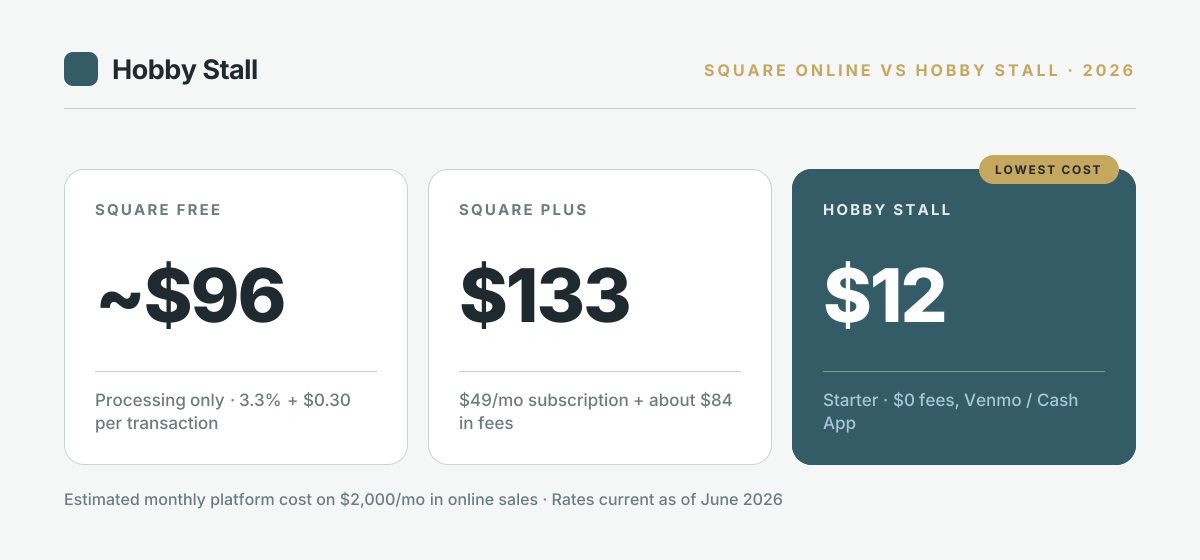
That tradeoff matters depending on your buyers. Card checkout with Square is frictionless for buyers who don't use Venmo. If your customers are comfortable with Venmo or Cash App (most local-market buyers already are), Hobby Stall's zero-fee model puts meaningfully more money in your pocket on every order.
Local pickup setup
Both platforms support local pickup, but the configuration experience and underlying model are different.
Square Online lets you set pickup locations with prep time, pickup windows, eligible items, and order pausing. Buyers check out online with a card, choose pickup, and get a confirmation with the pickup details. Orders appear in your Square dashboard and POS. If you're managing a pickup window around a weekly farmers market, you'd configure the pickup availability hours to match. Square also supports order-ahead preorders with a specific availability date, which works well for items you're preparing in batches.
Hobby Stall pickup works through the drop or always-on mode. Sellers create pickup options with a label, instructions, and available time slots, and those options appear at checkout. Buyers claim items, select a pickup option, and receive a receipt with your Venmo or Cash App handle. Payment happens out of band before pickup. Claims that go unpaid for 48 hours release automatically back to available inventory, so you're not holding stock for buyers who ghost.
The structural difference: Square treats pickup as a fulfillment method on top of a normal cart checkout. Hobby Stall treats pickup as part of a claim-and-confirm flow where payment confirmation is a separate step.
Drop-style and batch selling
If you sell in timed batches, this is the section that matters most.
Square Online supports preorders with availability dates and quantity limits. You can set an item to become available on a specific date and limit how many are sold. What it doesn't have is a native concept of a drop: a named, time-bounded event with a countdown, a curated collection of items, a live-state that opens and closes, and a storefront experience designed around scarcity and timing.
Hobby Stall drops are exactly that. You create a drop with a name, open and close window, password protection if you want it, and a product group layout. The storefront shows a countdown to open, a selection bar while the drop is live, and a "Coming up" list for scheduled future drops. Growth-tier shops can run multiple drops simultaneously with a sticky table-of-contents nav. Always-on mode runs alongside drops for evergreen inventory.
For a cottage food seller doing a weekly Friday baked goods release or a monthly specialty jam batch, that structure maps directly to how you already operate. Square's preorder tools require more workarounds to recreate the same experience.
Inventory and catalog
Square Online's item catalog syncs with Square POS, which is a genuine advantage if you sell in-person and online. Changes to items, prices, or stock levels propagate across channels. Inventory tracking is built in, including variants (size, flavor) and modifiers.
Hobby Stall's catalog is focused on small-batch sellers. Products have attributes, categories, and up to three photos on the Growth plan (one on Starter). The catalog pushes items into drops or always-on mode manually. There's no POS sync because Hobby Stall isn't a POS. For sellers who handle in-person and online sales separately, that's fine. For sellers who want a single source of truth across both, Square's ecosystem is more practical.
CRM and buyer data
Square has a customer directory that collects buyer contact info at checkout, tracks purchase history, and integrates with Square's marketing tools. You can segment customers, send emails, and build loyalty programs through the Square ecosystem, with more features available on paid plans.
Hobby Stall's Growth plan includes a buyer CRM that aggregates customers across orders by phone number, shows lifetime value and order history, and lets you add notes and tags. The Starter plan includes the Shop Alerts subscriber list, where buyers can sign up for drop notifications directly from your storefront. Broadcast email tools are planned for a future update.
For a cottage food seller, the Hobby Stall CRM gives you the customer visibility you actually need: who's buying consistently, what they've ordered, and how to reach them for your next drop. Square's tools go deeper but are oriented around a higher-volume, multi-channel retail operation.
When Square Online makes more sense
- You already use Square POS at farmers markets or pop-ups and want online orders in the same system
- Your buyers expect card checkout and aren't using Venmo or Cash App
- You sell across multiple locations or need full inventory sync between online and in-person
- You want built-in loyalty programs, marketing campaigns, and POS-level analytics
When Hobby Stall makes more sense
- You run scheduled batch releases, weekly drops, or limited-quantity events
- You want zero transaction fees and your buyers use Venmo or Cash App
- You're a cottage food seller who needs a clean branded storefront without managing a full POS ecosystem
- You want preorder-style claim windows with automatic unpaid-order cleanup
For a cottage food seller who's primarily selling online with local pickup, Hobby Stall's pricing model means the platform pays for itself at relatively low volume. At $12/month with no transaction fees, you keep more of each order than you would on Square Free or Plus. The tradeoff is payment friction for buyers who don't use peer-to-peer payment apps, and no POS integration if you also sell in person.
The first month on either Hobby Stall plan is $1. Start your shop or review the pricing page to compare tiers.
This post is general information. Pricing and features for all platforms are subject to change. Verify current rates directly with Square and Hobby Stall before deciding.
Frequently asked questions
- Does Square Online charge transaction fees on cottage food sales?
- Yes. Square Online charges payment processing fees on every order. As of June 2026, the Square Free plan charges 3.3% + $0.30 per online transaction. Upgrading to Square Plus ($49/month) lowers that to 2.9% + $0.30. Hobby Stall does not process buyer payments at all, so there are no per-order fees. Buyers pay sellers directly via Venmo or Cash App.
- Can I run drop-style limited batch sales on Square Online?
- Square Online supports preorders with a specified availability date and quantity limits per item. It does not have a native drop scheduling system with countdowns, batch-claim windows, or a storefront designed around timed release events. Hobby Stall's drops mode is purpose-built for that workflow, with scheduled windows, live countdowns, and automatic claim release for unpaid orders.
- Which platform is better if I already use Square for in-person sales at a farmers market?
- Square Online is the stronger choice if you already use Square POS at markets. Your inventory, item catalog, and sales data stay in one system, and customers can place online preorders that sync with your in-person setup. Hobby Stall is a better fit if your goal is to run scheduled online drops with local pickup and you don't need POS integration.
- Does Hobby Stall support local pickup?
- Yes. Hobby Stall sellers configure pickup options with a description, location instructions, and available time windows. Buyers select a pickup option at checkout and receive a receipt with the seller's Venmo or Cash App handle to complete payment. Pickup is available on both the Starter and Growth plans.
- What does Square Online cost per month?
- Square Online is available at no monthly subscription cost on the Square Free plan, with online processing fees of 3.3% + $0.30 per transaction as of June 2026. Square Plus costs $49 per month and lowers online processing to 2.9% + $0.30. Hobby Stall's Starter plan is $12 per month (or $108 per year), with no transaction fees on orders.
- Can I build an email subscriber list on Square Online?
- Yes, Square has built-in customer directory and marketing tools. You can collect customer emails at checkout and send marketing campaigns, though advanced marketing features require a paid Square plan. Hobby Stall's Shop Alerts feature lets buyers subscribe to drop notifications directly from your storefront, with seller-facing subscriber lists available on the Starter plan and broadcast email tools planned for a future update.
Keep reading
- The Best Etsy Alternatives for Local Sellers (Drops, Preorders, and Pickup)
Honest picks for makers who sell to their own city: drop-based shops, preorder tools, and local pickup workflows that don't bleed margin to marketplace fees.
- Big Cartel vs Shopify: Cost and Caps Compared
Big Cartel is cheaper and simpler. Shopify does more and costs more. The honest split on price, product caps, drops, and local pickup.
- How to Price Home-Roasted Coffee (With Real-World Math Examples)
A practical pricing guide for home coffee roasters and micro-roasteries selling at farmers markets, local pickup, or online drops.