Cottage Food Guide for Illinois
By Stephen Campbell · June 11, 2026 · 8 min read
Illinois is one of the most permissive cottage food states in the country. You can sell almost any non-hazardous food you make at home — baked goods, jams, dry mixes, roasted coffee, fermented foods — directly to customers with no annual sales cap, after registering with your local health department (≤ $50/year) and earning a food manager certification. Here's exactly what that means in practice.
What is a cottage food operation in Illinois?
Under the Food Handling Regulation Enforcement Act, 410 ILCS 625/4, a cottage food operation is a home-based business run by a person who produces or packages food or drink — other than items on the statutory prohibited list — in a primary domestic residence or farm kitchen, for direct sale to consumers. The law was significantly expanded by the Home-to-Market Act (SB 2007 / P.A. 102-0633), which took effect January 1, 2022, removing the old farmers-market-only restriction and eliminating the monthly sales cap. The Illinois Department of Public Health (IDPH) and your local county health department share oversight.
What can you sell from a home kitchen?
Illinois uses a prohibited-list model: if a food isn't on the banned list, it's presumptively allowed — as long as it doesn't require time/temperature control (refrigeration) to stay safe.
Allowed categories
- Baked goods without cream, custard, or hazardous fillings
- Candies and confections
- Jams, jellies, preserves, and fruit butters
- Dried herbs, spices, and seasonings
- Dry mixes (granola, trail mix, baking mixes)
- Honey and maple syrup
- Dehydrated foods
- Popcorn and kettle corn
- High-acid canned goods (using USDA or Extension-tested recipes)
- Acidified/fermented foods (pickles, hot sauce, kimchi) — with pH testing ≤ 4.6 or an approved recipe
- Some cheese-containing baked goods — with water-activity lab testing
- Roasted coffee beans and ground coffee — shelf-stable, non-perishable, not on the prohibited list (more on this below)
Prohibited foods
| Category | Notes |
|---|---|
| Meat, poultry, fish, seafood, shellfish | Fully prohibited |
| Dairy as a primary component | Exception: dairy as an ingredient in non-hazardous baked goods, candy, or frosting |
| Raw eggs | Exception: eggs baked into non-hazardous foods or used in shelf-stable frosting |
| Pumpkin pies, cheesecakes, custard/crème pies | Hazardous fillings and toppings |
| Low-acid canned foods | Requires approved facility |
| Garlic-in-oil (non-acidified) | Botulism risk |
| Cut leafy greens | Unless dehydrated, acidified, or blanched and frozen |
| Wild-harvested mushrooms | Fully prohibited |
| Alcoholic beverages and kombucha | Fully prohibited |
| Ready-to-drink brewed coffee or cold brew | Food-service product; requires retail food license |
Source: IDPH Cottage Food overview and 410 ILCS 625/4.
Higher-risk but allowed: what requires extra steps
Acidified and fermented foods (pickles, hot sauce, kimchi, vinegar-based BBQ sauces): you must either use a USDA/Extension-approved tested recipe, or have a documented food-safety plan plus a lab pH test confirming pH ≤ 4.6. That test result must be renewed every three years.
High-acid canned tomatoes: must follow a tested recipe (Ball Blue Book, the USDA Complete Guide to Home Canning, or Illinois Extension) or be lab-verified for acidity.
Baked goods with cream cheese or other soft cheese: allowed if non-hazardous, but local health departments may require water-activity testing to confirm shelf stability.
Registration, certification, and costs
Registration
Before your first sale, you must register annually with the local health department in the county where you live. Per 410 ILCS 625/4, the fee is capped at $50/year, though some counties charge less or nothing. Registration gives you a certificate and a registration number that must appear on every product label.
Food safety certification
Everyone who prepares or packages cottage food must hold a current ANSI/ANAB-accredited Certified Food Protection Manager (CFPM) certificate. This is typically an 8-hour course plus a proctored exam (ServSafe, NRFSP, or Prometric are common providers) costing roughly $100–$300, and is valid for five years. Staff who only handle sales and never touch food prep are exempt.
There is no annual sales cap for Cottage Food Operations under 410 ILCS 625/4. The $1,000/month cap that sometimes circulates online applies only to the separate Home Kitchen Operation category (410 ILCS 625/3.6), which some municipalities use — it's a different tier.
At-a-glance setup costs
| Item | Cost |
|---|---|
| Annual health department registration | $0–$50 |
| CFPM course + exam | ~$100–$300 (one-time; valid 5 years) |
| Label printing (inkjet or label service) | Varies |
| pH testing for fermented/acidified foods | ~$50–$150/product/recipe |
| Total first-year startup compliance | ~$150–$400 |
Labeling: the exact checklist
Every packaged cottage food product sold in Illinois must include all of the following. This is pulled directly from the IDPH Cottage Food labeling checklist:
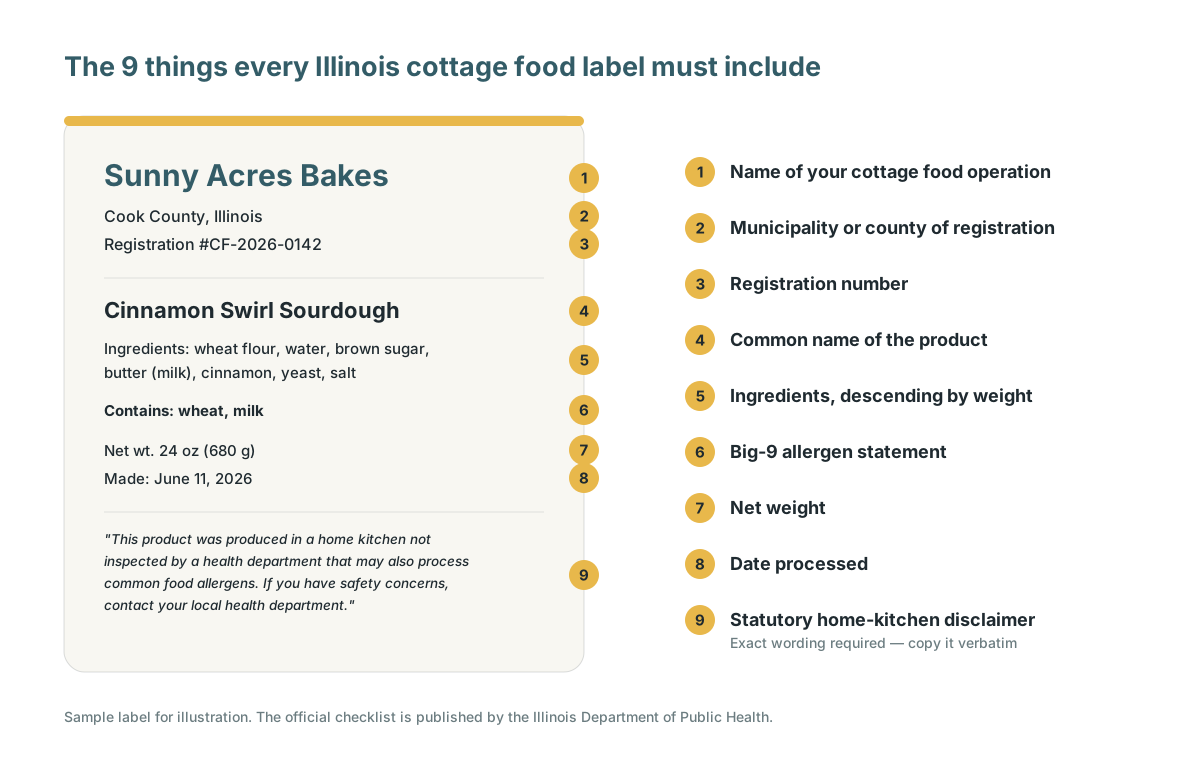
- Name of your cottage food operation
- Municipality or county where the operation is registered
- Registration number issued by the local health department
- Common or usual name of the food product
- Complete ingredient list in descending order by weight, including colors, artificial flavors, preservatives, and sub-ingredients, all in plain language
- Allergen labeling per federal Big-9 rules (milk, eggs, fish, shellfish, tree nuts, peanuts, wheat, soybeans, sesame) — either inline in the ingredient list or as a "Contains: …" statement
- Net weight of the product
- Date the product was processed (made)
- The exact statutory disclaimer, in prominent lettering:
"This product was produced in a home kitchen not inspected by a health department that may also process common food allergens. If you have safety concerns, contact your local health department."
Exemptions: if pre-packaging is impractical (very small items, bulk goods), your local health department may grant a written exemption. In that case, you must display all the same information via a placard, table tent, or other prominent written notice at the point of sale.
Where you can sell
The Home-to-Market Act opened up far more than farmers markets. Here's the full matrix:
| Sales channel | Allowed? |
|---|---|
| Farmers markets (including mobile) | ✅ Yes — mobile farmers markets added by P.A. 103-903 (2024) |
| Fairs and festivals | ✅ Yes |
| Home or farm pickup | ✅ Yes, subject to local zoning |
| Online sales (within Illinois) | ✅ Yes |
| Direct delivery (within Illinois) | ✅ Yes |
| Pickup from third-party private property | ✅ Yes, with property owner consent |
| In-state shipping (non-TCS shelf-stable only) | ✅ Yes, in tamper-evident packaging |
| Out-of-state shipping | ❌ No — interstate commerce is FDA-regulated |
| Wholesale to restaurants or grocery stores | ❌ No — cottage food is not an "approved source" |
| Selling as an ingredient to food businesses | ❌ No |
Per 410 ILCS 625/4, cottage food products must be sold "directly to consumers for their own consumption and not for resale." The IDPH confirms that food prepared in a private home may not be used in a food establishment as an ingredient or offered-for-sale product.
Can you sell home-roasted coffee?
Short answer: yes, with a caveat on ready-to-drink.
Roasted coffee beans and ground coffee are not on Illinois' prohibited list. The statute permits any food or drink not otherwise prohibited, and roasted or ground coffee is a shelf-stable, low-moisture, non-hazardous dry product — exactly the profile the law is designed to accommodate. University of Illinois Extension describes allowed products as "any food or drink NOT on the prohibited list," which covers shelf-stable dry goods like coffee and tea.
Running a micro-roastery (as I did with Daymark Coffee here in Chicago) fits squarely into this model: whole-bean bags, ground-to-order bags, and even custom blends sold at farmers markets or shipped within Illinois are consistent with cottage food rules.
What is not covered:
- Brewed hot coffee, cold brew concentrate, or canned/bottled coffee beverages — these are food-service or processed food products requiring a retail food establishment license and an approved, inspected production facility.
- Wholesale supply to cafés or grocery stores — the "approved source" prohibition applies. Even if your coffee is excellent, a café cannot legally source it from your home kitchen.
Important caveat: Illinois law and official IDPH guidance do not explicitly name roasted coffee as allowed or prohibited. The interpretation rests on the general "not prohibited" framework. Before you start selling, confirm in writing with your county health department — especially if you plan to scale or sell specialty blends with any added ingredients (flavored syrups, spice blends, etc.).
Recent changes to Illinois cottage food law
Illinois has moved steadily toward more food freedom over the past decade:
- 2012 — Original Cottage Food Law: limited to non-hazardous baked goods, jams, and dried herbs sold only at farmers markets
- 2018 — Expansion: added more food categories and some chilled/canned products
- January 2022 — Home-to-Market Act (SB 2007 / P.A. 102-0633): removed the farmers-market-only restriction, eliminated the monthly sales cap, opened online/delivery/home pickup channels
- 2024 — P.A. 103-903 added mobile farmers markets as an allowed sales venue; University of Illinois Extension updated its Cottage Food Guide
- 2026 — University of Illinois Extension published a 2026 addendum reflecting current laws, rules, and safety standards
Pending: HB 4121 proposed allowing some indirect retail sales through retailers under specified conditions. As of early 2026 it remains pending — do not rely on it until enacted; check the Illinois General Assembly site for current status.
Official resources
| Agency | Role | Link |
|---|---|---|
| Illinois Department of Public Health (IDPH) | Main regulatory authority; labeling checklist | dph.illinois.gov |
| University of Illinois Extension — Cottage Food | Educational guides, training, FAQ | extension.illinois.edu/cottage-food |
| Your local county health department | Registration, fee collection, complaint inspections | Search "[your county] health department cottage food Illinois" |
| Illinois General Assembly | Full statutory text of 410 ILCS 625 | ilga.gov |
Inspections: Illinois does not require a routine home kitchen inspection before registration approval. Local health departments may inspect a cottage food operation if there is a complaint or reason to believe the law is being violated. Keep your registration certificate accessible when vending, especially outside your home county.
This guide is for general information, not legal advice — always confirm current requirements with your county health department. See also Hobby Stall's cottage food resource page. Once you're registered and labeled, a Hobby Stall shop handles the orders-and-pickup side: post what you baked, let neighbors claim it, get paid by Venmo or Cash App.
Frequently asked questions
- Do I need a license or a registration to sell cottage food in Illinois?
- You need an annual registration (not a full food processing license) from your local county health department. The fee is capped at $50 per year under 410 ILCS 625/4. You will also need a current Certified Food Protection Manager (CFPM) certification before you can prepare or package food for sale.
- Is there a sales limit for Illinois cottage food operations?
- No. Under the Home-to-Market Act (P.A. 102-0633, effective January 1, 2022), there is no annual or monthly sales cap for Cottage Food Operations under 410 ILCS 625/4. The $1,000-per-month cap that circulates online applies only to the separate Home Kitchen Operation tier (410 ILCS 625/3.6), which is a different category used in some municipalities.
- Can I sell pickles, hot sauce, salsa, or kimchi from my home kitchen?
- Yes, but with extra requirements. Acidified and fermented foods require either a USDA or Extension-approved tested recipe, or a documented food-safety plan plus a lab pH test confirming pH at or below 4.6. That test must be renewed every three years. Confirm your specific recipe with your county health department before selling.
- Can I sell cheesecakes, cream pies, or pumpkin pies?
- No. Pumpkin pies, sweet potato pies, cheesecakes, custard pies, and creme-filled pastries are explicitly prohibited under Illinois cottage food law because they require temperature control for safety. Non-hazardous baked goods with cream cheese as a minor ingredient may be allowed with water-activity testing — check with your county health department.
- What exactly has to go on my label?
- Your label needs: business name, registered county or municipality, your registration number, product name, full ingredient list in descending weight order, Big-9 allergen disclosure, net weight, processing date, and the exact statutory disclaimer: "This product was produced in a home kitchen not inspected by a health department that may also process common food allergens. If you have safety concerns, contact your local health department." See the IDPH labeling checklist for the official version.
- Can I ship my cottage food products?
- Within Illinois, yes — for non-perishable, shelf-stable products only, in tamper-evident packaging. Out-of-state shipping is not permitted under cottage food exemptions; interstate commerce is regulated by the FDA and falls outside state cottage food law protections.
- Will my kitchen be inspected, and how often?
- Illinois does not require a routine pre-registration home kitchen inspection. Local health departments conduct inspections only if there is a consumer complaint or reason to believe the law is being violated — not on a scheduled basis. Keep your registration certificate handy when vending at events outside your home county.
Keep reading
- California Cottage Food Law: A 2026 Guide for Home Bakers and Makers
California cottage food law lets you sell from your home kitchen with no inspection required. Learn Class A vs Class B permits, allowed foods, sales caps, and labeling rules as of June 2026.
- Colorado Cottage Food Law: A 2026 Guide for Home Bakers and Makers
Colorado's cottage food law caps revenue per product at $10,000 annually, requires food safety training and business registration, and allows a wide range of shelf-stable foods. Learn the rules, labeling requirements, and allowed products as of June 2026.
- How to Take Preorders for Baked Goods (Without Drowning in DMs)
A practical guide for home bakers: why DM preorders break down, how the drop model works, and how to pick the right tool for weekly batches.