How to Price Home-Roasted Coffee (With Real-World Math Examples)
By Hobby Stall Team · June 12, 2026 · 5 min read
Pricing home-roasted coffee is deceptively tricky. Green coffee costs are obvious, but roasters often forget to include bags, labels, waste, equipment, and their own time. The result is beautifully roasted coffee that barely breaks even. This guide walks through a simple framework and step-by-step math you can adapt to your own micro-roastery.
Step 1: Know your cost per roasted pound
Start by calculating your true cost per roasted pound, not just the green coffee price.
Core cost components
- Green coffee per roasted pound — beans lose roughly 12–20% of their weight during roasting depending on roast level (15% is a fair planning number). If you price from the green per-pound cost, you'll underprice every bag.
- Packaging and labels — bags, valves, labels, and any printed inserts or stickers.
- Roaster fuel or electricity — small per batch, but real, especially if you roast frequently.
- Labor (your time) — roasting, bagging, labeling, cleaning, and managing orders.
- Overhead — registration fees, insurance, and selling tools, spread across your expected production.
Example: cost per roasted pound
Suppose green coffee costs $6.00 per pound, your roast profile loses 15%, and you roast 10 lbs of green at a time.
10 lbs (4,536 g) of green at 15% loss yields about 3,856 g — 8.5 lbs roasted. So your green cost per roasted pound is:
- $6.00 × 10 lbs = $60 of green per batch
- $60 ÷ 8.5 roasted lbs ≈ $7.06 per roasted pound
Now add, per roasted pound:
| Cost | Per roasted lb |
|---|---|
| Green coffee | $7.06 |
| Packaging + labels ($0.55 per 12 oz bag ≈ 1.33 bags/lb) | $0.73 |
| Fuel and utilities (estimate) | $0.60 |
| Overhead spread across expected volume (estimate) | $0.50 |
| Cost before labor | ≈ $8.89 |
Step 2: Decide how to pay yourself
Many hobby roasters forget to pay themselves at all — or pick an hourly rate that would never survive outside a spreadsheet.
Estimate time per batch (setup, roasting, cooling, cleanup) and time per pound for bagging, labeling, and order management. For example:
- A 10 lb batch takes 1.5 hours end to end
- Bagging and labeling takes another 0.5 hours
- Total: 2 hours for 10 roasted pounds → 0.2 hours per pound
At $25/hour for production work, labor is 0.2 × $25 = $5.00 per pound, bringing the running total to:
- $8.89 + $5.00 ≈ $13.89 per pound, fully loaded
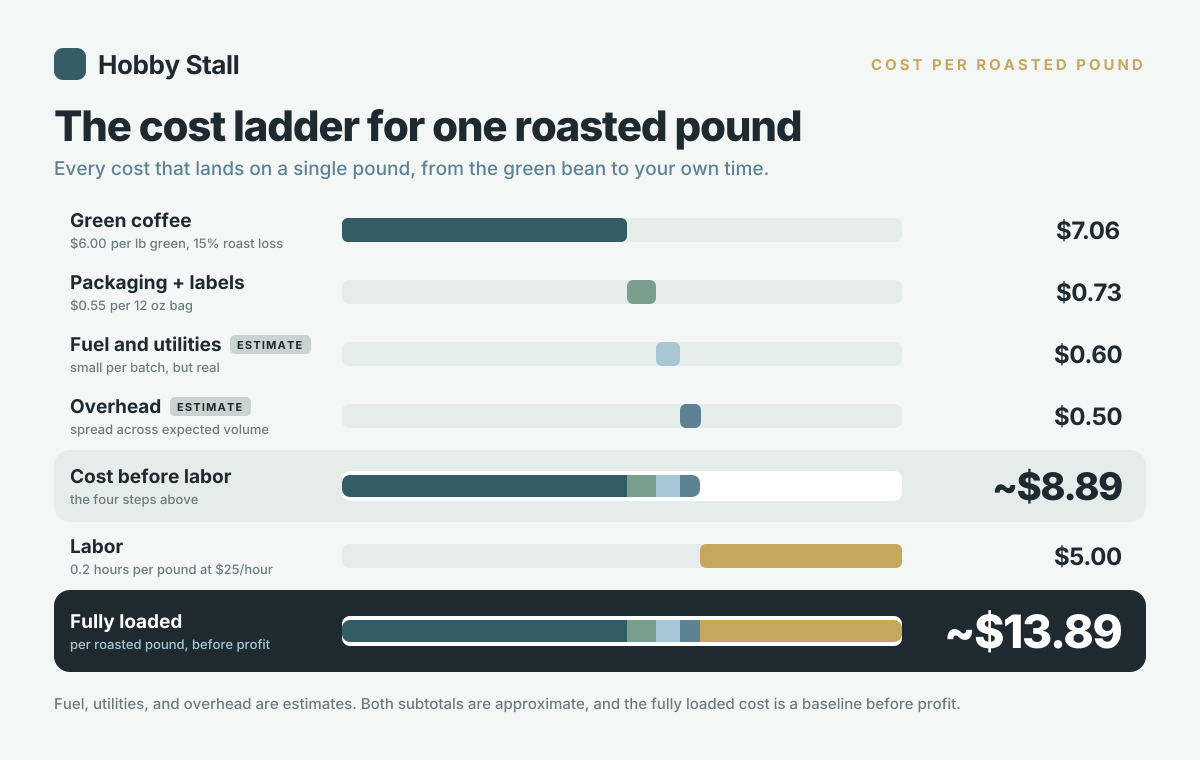
This is your baseline before profit.
Step 3: Set your margin and retail price
For small-batch food and beverage products, a gross margin of 50–65% is a common target, where margin = (price − cost) ÷ price.
From the $13.89 example cost:
- At 50% margin: $13.89 ÷ 0.50 ≈ $27.78 per pound
- At 55% margin: $13.89 ÷ 0.45 ≈ $30.87 per pound
Most specialty coffee sells in 10–12 oz bags, not full pounds. A 12 oz bag is 0.75 lb, so:
- 50% margin → 0.75 × $27.78 ≈ $20.83 per 12 oz bag
- 55% margin → 0.75 × $30.87 ≈ $23.15 per 12 oz bag
Round to clean price points ($21, $22.50) while keeping an eye on the underlying margin.
If those numbers feel high for your market, adjust your inputs — don't just slash profit:
- Choose slightly lower-cost green while staying within your quality bar
- Dial in batching to reduce labor per pound
- Simplify packaging while still meeting food-safety and branding needs
Step 4: Farmers market vs. local pickup vs. shipping
Your channel affects pricing because each adds different costs.
Farmers markets
High trial volume and visibility — but booth fees, setup and staffing time, and sample giveaways all cost something. Handle it by nudging your base price or treating the market as a customer-acquisition cost that your repeat-order channels pay back. (Note: under cottage food rules you generally can't sell brewed coffee — that's a food-service product — and whether you can hand out free brewed samples is governed by your market organizer and local health department. Ask before you pour.)
Local pickup via preorder drops
Local preorder drops — for example through Hobby Stall — mean a single pickup window at a consistent location, claims that close when the batch is gone, and buyers paying you directly by Venmo or Cash App. Keep bag pricing consistent with your other channels, and if you offer neighborhood delivery, charge a separate, transparent delivery fee rather than absorbing the time and fuel invisibly.
Shipping
If your state's cottage food law allows in-state shipping of shelf-stable products — as Illinois does (see our Illinois cottage food guide) — account for boxes and fillers, weight-based carrier rates, and packing time. Many micro-roasters set a flat in-state shipping fee that roughly matches typical carrier cost plus a small buffer, and keep product prices identical across channels.
Step 5: Use tiers for recurring orders — and know the wholesale wall
Even selling direct-to-consumer, you'll eventually get asked about office coffee, "coffee club" subscriptions, or bulk discounts.
- DTC baseline — the retail math above is your anchor for single bags.
- Recurring orders — discount with care: 5–10% for a monthly standing order, with a minimum bags-per-cycle to protect margin. The discount is justified by what recurring orders save you (less marketing, smoother production planning) — not by generosity.
- Wholesale — under cottage food rules this is usually off the table: restaurants and grocers must buy from approved sources, which excludes home kitchens (Illinois states this explicitly — see the IDPH cottage food page). Pursuing wholesale generally means a licensed commercial facility and a different permitting path.
Step 6: Sanity-check against your market
Once the math is done, compare against other local roasters of similar quality, national specialty brands, and what your ideal customers already pay for a good bag.
If your math says $23 per 12 oz and local peers charge $18 for comparable coffee, you have decisions to make: Are you offering meaningfully higher quality or a story that justifies the premium? Are your batch sizes or time estimates inefficient? Is your packaging overbuilt for your stage? The answer is rarely "just charge less" — refine your inputs or your value proposition until the price you need matches what customers will pay.
Step 7: Make your pricing easy to understand
Customers pay premiums more comfortably when they understand what they're paying for: consistent pricing across channels, a simple story about sourcing (region, process, roast level) and batch size, and occasional behind-the-scenes content from roast day. A drop model works well here — each drop features a few coffees with clear notes, transparent pricing, and the story behind each lot. (That's how Daymark Coffee, the founder's own micro-roastery, runs on Hobby Stall.)
Plug your own green cost, batch size, and time per batch into the formula above before your next drop — and if you want the drop-and-pickup side handled for you, start your shop.
Frequently asked questions
- How much weight does coffee lose during roasting?
- Roughly 12-20% depending on roast level and bean moisture — lighter roasts lose less, darker roasts more. 15% is a reasonable planning number. The practical consequence: always price from your cost per ROASTED pound, not the green price.
- What profit margin should a small coffee roaster aim for?
- A gross margin of 50-65% is a common target for small-batch food and beverage products — meaning the price is roughly two to three times your fully loaded cost per bag, including your labor. Below that, packaging, mistakes, and unsold inventory eat the difference.
- Why does my home-roasted coffee cost more than grocery store coffee?
- You're not competing with grocery coffee. Small batches mean higher per-pound costs for green coffee, packaging, and especially labor. Your comparison set is local specialty roasters and quality-focused national brands — and your freshness and story are the justification.
- Can I sell my roasted coffee wholesale to a cafe under cottage food rules?
- Generally no. Cottage food laws restrict sales to direct-to-consumer, and food businesses must buy from approved sources — which excludes home kitchens. Supplying cafes or grocers usually requires a licensed commercial facility and a different permitting path.
Keep reading
- How to Sell Handmade Online Without Etsy (Especially If You Sell Locally)
A practical guide for small-batch makers who want to sell handmade products online without relying on Etsy, especially if most of your customers are local.
- How to Sell Home-Roasted Coffee Legally (and Locally)
A practical guide for home and micro-roasters: where roasted coffee fits under cottage food law, what's never covered, and how to sell locally through drops.
- The Best Etsy Alternatives for Local Sellers (Drops, Preorders, and Pickup)
Honest picks for makers who sell to their own city: drop-based shops, preorder tools, and local pickup workflows that don't bleed margin to marketplace fees.