The Best Etsy Alternatives for Local Sellers (Drops, Preorders, and Pickup)
By Hobby Stall Team · June 12, 2026 · 7 min read
If you sell mostly to your own neighborhood, Etsy starts to feel like the wrong shape. The fees stack, the search results favor global volume, and nothing about the platform helps you run a Friday drop for local pickup. This post walks through the realistic options for local sellers running drops, preorders, and pickup, with the actual cost math from each platform's pricing page.
Why local sellers outgrow Etsy
Etsy is built for one job: connect a global audience with a global catalog. For a potter in Cincinnati selling 30 mugs a month to people who already follow her work, that's a strange fit.
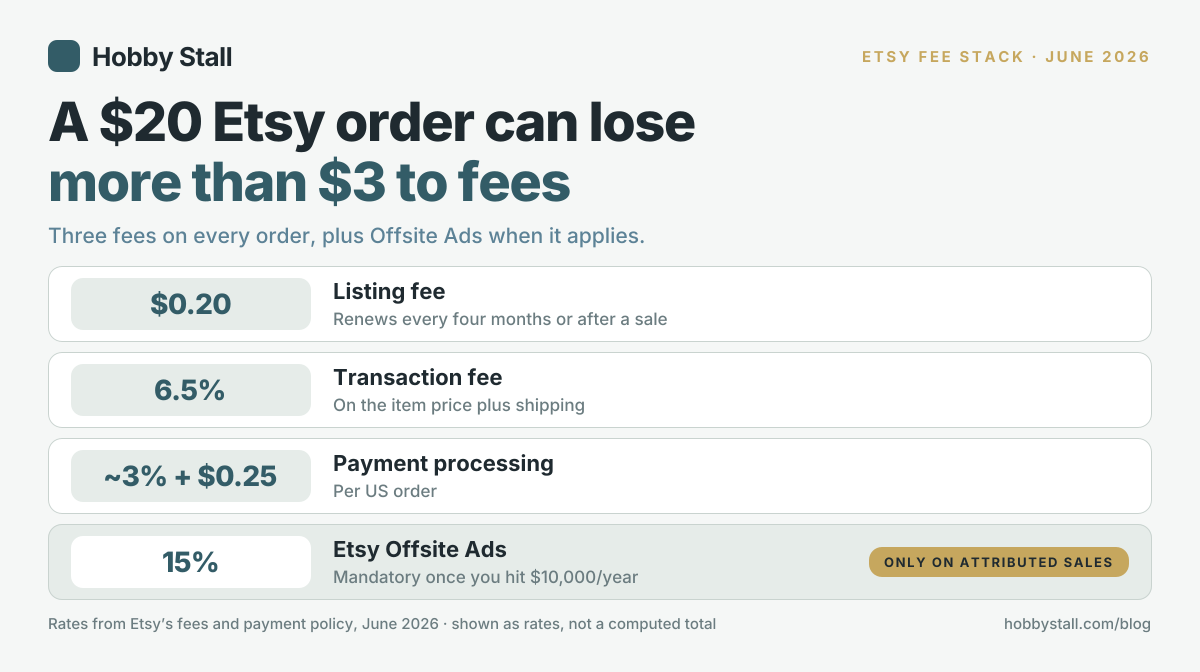
A typical US Etsy sale runs three fees in parallel, per the Etsy fees and payment policy (as of June 2026):
- A $0.20 listing fee that renews every four months or after a sale
- A 6.5% transaction fee on the item price plus shipping
- Payment processing, around 3% plus $0.25 per US order
Add Etsy Offsite Ads (15% of attributed sales for shops under $10,000/year, mandatory once you hit that threshold) and a $20 order can lose more than $3 to fees before you factor in materials. None of those fees pay for local discovery. Etsy doesn't surface you to people in your zip code; it surfaces you to whoever the algorithm thinks will buy.
There's a second cost that's harder to measure. Etsy puts competing listings on your product pages, which is great for buyers and bad for sellers trying to build a repeat customer base. Every order is a single-shot transaction. Many sellers say the same thing when they leave: the work of driving traffic was theirs, the audience never was.
The honest comparison
Here's how the main options shake out for a maker selling locally in 2026. All numbers are from each platform's official pricing page, as of June 2026.
| Platform | Monthly cost | Per-sale fee | Drop / preorder support | Local pickup workflow | Best fit |
|---|---|---|---|---|---|
| Etsy | $0 | $0.20 listing + 6.5% transaction + processing + optional Offsite Ads | None native | None native | National handmade reach, gift discovery |
| Shopify | $39 Basic (monthly) | Card processing from 2.9% + $0.30 | Via paid apps | Possible, needs setup | Steady-volume catalog stores |
| Big Cartel | $0 Gold / $15 Platinum / $30 Diamond | No Big Cartel transaction fee; processor only | Manual publish / unpublish | None native | A few products, very low budget |
| Square Online | $0 Free / $49 Plus | 3.3% + $0.30 online (Free) or 2.9% + $0.30 (Plus) | Limited | Yes (POS-first) | Sellers already on Square in-person |
| Hotplate | $0 | 2.9% + $0.30 processing, plus 5% + $0.55 added to customer at checkout | Yes (food only) | Yes (food pickup) | Pop-up food businesses |
| Instagram DMs | $0 | Whatever your payment app charges | Vibes | "Meet at the coffee shop" | Your first ten orders, maybe |
| Hobby Stall | Flat monthly subscription | None. 0% commission. Buyers pay you direct via Venmo or Cash App | Native | Native | Drop-based local hobby sellers |
A few things worth saying out loud about that table.
Etsy lists at $0/month because there's no subscription, but the per-sale stack is the highest of any option once Offsite Ads kick in. Shopify's $39 is the entry sticker price; the apps for preorders and drop scheduling usually push the real number higher. Big Cartel is cheap and clean, but you'll manually flip listings on and off when your batch sells out. Square's online store is fine if you're already running Square at a market, but the page builder is basic and the Free plan now sits at 3.3% plus $0.30 online (which Square raised in January 2026, per their fee schedule).
Hotplate gets called out a lot in food-seller circles, and rightly: it nails the drop model. The catch is the 5% + $0.55 customer-facing fee on top of processing, which lands on top of your prices at checkout. If you're selling $8 cookies, customers see the line item. Some don't mind. Some do.
Instagram DMs deserve their own row because they're how most makers actually start. They work for a while. They fall apart somewhere between order 15 and order 50, when you can't remember who paid, who picked up, and which Venmo was for the bagels versus the candles.
What's actually different about Hobby Stall
Hobby Stall is built for the local-drops case. Specifically:
- Scheduled drops with claim windows. You open the drop Monday, close it Thursday, and the storefront enforces that.
- Preorders by default. Customers reserve, you bake or throw or roast, they pick up.
- Local pickup as a first-class workflow, not an afterthought toggle.
- Venmo and Cash App handoff. The money goes from your buyer to you, not through a marketplace's payout system.
- A flat monthly subscription with 0% commission. See pricing for current tiers.
That last point is the one that changes the math. When the platform takes no cut of your sale, a $20 mug nets you the full $20 minus whatever Venmo or Cash App quietly does on their end (often nothing for personal transfers). Compare that to Etsy taking roughly $2 to $3 out of the same $20 order and it adds up faster than people expect.
The honest counter: Hobby Stall doesn't bring you traffic. Neither do Shopify, Big Cartel, or Square Online. If you don't have an audience yet, you're going to do the work of building one regardless of platform. That's where the local SEO post for potters and the wider guide to selling handmade without Etsy get into the practical playbook.
The small marketplaces that keep failing
A reasonable question: why not just join a smaller handmade marketplace with lower fees?
GoImagine, the curated handmade marketplace that positioned itself as "the ethical Etsy," announced in early 2026 that it was shutting down. Per the reporting on the closure, the operating cost was around $40,000 a month and the founder couldn't sustain it. Sellers had until early April 2026 to export their listings.
That pattern repeats. Bonanza, Aftcra, Zibbet, and several others have either folded, pivoted, or gone quiet over the last decade. The reason is structural. A marketplace's value proposition is the audience it sends you. If the marketplace can't fund the marketing spend that brings buyers in, sellers see no orders, leave, and the flywheel stalls.
The lesson isn't "marketplaces are bad." It's that joining a smaller marketplace doesn't actually solve the underlying problem. You're still doing the traffic work, just for a brand with less reach than Etsy. If you're going to drive your own traffic anyway, you might as well drive it to a storefront where you keep the customer relationship.
How to choose by seller type
The right platform depends on what you make and how you sell it. A short decision guide.
Home bakers and cottage food sellers. You want preorders, pickup windows, and a workflow that handles "ordering closes Wednesday, pickup Saturday." Hotplate fits if you're okay with the customer-facing fee. Hobby Stall fits if you want the seller-pays-flat-subscription model. Etsy doesn't really apply because most cottage food laws ban out-of-state shipping anyway. See the Illinois cottage food guide for an example of how state law shapes your options.
Potters and ceramicists. Drops are already cultural in pottery, often called "shop updates." You want a tool that supports a small batch released on a schedule, claim-style checkout, and either local pickup or careful shipping. A drop-focused storefront fits well. Etsy can work as a discovery surface for one-off pieces if you're okay with the fees.
Jewelry makers. Etsy is genuinely strong for national jewelry discovery. Many jewelers run an Etsy shop for reach plus their own storefront for repeat customers and custom orders, then quietly let the Etsy shop ride. If you're local-only (custom name necklaces for your city's wedding crowd, say), the Etsy fees probably aren't earning their keep.
Candle makers. Seasonal drops align well with how candle buyers shop. Big Cartel is cheap and gets the job done for a small line. A drop-focused tool fits better once you're running seasonal launches with waitlists.
Coffee roasters. Most home roasters sell locally because of cottage food rules and the freshness story. Drops with weekly pickup or local delivery fits the model. Etsy is a poor fit because shipping fresh coffee nationally as a hobby roaster is a regulatory minefield in many states.
The realistic path off Etsy
You don't have to flip a switch. The makers who handle this well treat it as a migration.
Keep the Etsy listings live but stop adding new ones. Print a small card that goes in every outgoing order pointing at your new shop URL. Email your repeat customers (you've been collecting emails, right?) and tell them where to find the next drop. Run one drop on your new storefront end-to-end before you close anything on Etsy. See what breaks.
The first drop will feel like nothing. The second one will be better. By the fifth, you'll have a rhythm: open Monday, close Thursday, batch Friday, pickup Saturday, write thank-you notes Sunday. That rhythm is the actual product. The platform is just where it lives.
If a drop-and-pickup shop sounds like the shape you want, start a Hobby Stall shop and run a single drop with your regulars before you change anything else. Compare the math against your last Etsy month and decide from there.
Frequently asked questions
- What's the best Etsy alternative if most of my customers are local?
- There isn't one universal answer, but the shortlist is small. If you sell in scheduled drops to a local crowd, a drop-focused tool with pickup workflows tends to fit better than a full Shopify build or a marketplace like Etsy. If you ship nationally and rely on strangers finding you, Etsy still has the audience advantage. Most local makers do best on a simple storefront they own plus an email list and a Google Business Profile.
- Are there really cheaper alternatives to Etsy, or do the fees just move around?
- The fees do move around, but the totals can be very different. Etsy stacks a listing fee, a per-sale transaction fee, payment processing, and optional or mandatory ad fees. A flat monthly subscription with no commission can come out far cheaper once you cross even a modest order volume. The right answer depends on how much you sell and what your average order is.
- Is Shopify a good Etsy alternative for a small hobby seller?
- Usually no, at least not at first. Shopify is built for catalog-driven stores running steady volume. For a home baker or potter doing one drop a month, the base subscription plus apps you'll end up needing for preorders or drop windows tends to outpace what you actually need. It becomes the right tool once volume and SKU count justify it.
- Can I keep my Etsy shop open while I try something else?
- Yes, and many makers do. Treat Etsy as a discovery surface for travelers and gift buyers, then send repeat and local customers to a storefront you control. Phase Etsy down once most of your regulars have moved, not on day one.
- How do customers find me if I'm not on Etsy?
- Three channels do most of the work for local sellers. An email list you actually email when you drop. Instagram or Facebook posts that always link back to your shop, not a marketplace. And local search, which means a Google Business Profile and city-specific wording on your storefront so you appear for 'near me' queries.
- What about Hotplate, GoImagine, and the smaller handmade marketplaces?
- Hotplate is food-only and charges customer-facing fees on top of payment processing. GoImagine announced in early 2026 that it was winding down, which is a cautionary tale: small handmade marketplaces without an existing audience usually can't drive enough traffic to justify their fees. The pattern keeps repeating.
- Do I need a real website to sell locally?
- You need a single URL you can share that takes orders. That can be a storefront on a platform, a Square Online page, a Big Cartel shop, or a Hobby Stall shop. What matters is that it lives at a stable web address you own the audience around, not a marketplace listing that can disappear when the algorithm shifts.
Keep reading
- Big Cartel vs Shopify: Cost and Caps Compared
Big Cartel is cheaper and simpler. Shopify does more and costs more. The honest split on price, product caps, drops, and local pickup.
- Square Online vs Hobby Stall for Cottage Food Sellers
Square Online and Hobby Stall both support local pickup and preorders, but they're built for different sellers. This comparison covers pricing, fees, local pickup setup, and which platform fits cottage food and home-based food businesses in 2026.
- Colorado Cottage Food Law: A 2026 Guide for Home Bakers and Makers
Colorado's cottage food law caps revenue per product at $10,000 annually, requires food safety training and business registration, and allows a wide range of shelf-stable foods. Learn the rules, labeling requirements, and allowed products as of June 2026.