
Ohio Cottage Food Law 2026: Cottage Food vs Home Bakery License
By Hobby Stall Team · November 10, 2026 · 10 min read
Ohio gives home food sellers two routes. Foods on the state's cottage food list (cookies, breads, jams, candy, roasted coffee and about a dozen other categories) need no license and no inspection, but you can only sell them inside Ohio. Anything that needs refrigeration, like cheesecake or a cream pie, moves to a home bakery registration: $10 a year after an inspection of your kitchen. Neither route has an annual sales cap. Here's how to tell which one you need, and what the label has to say.
Two ways to sell food from an Ohio kitchen
Both routes live in Ohio's food law rather than in a standalone cottage food act. The cottage food rules are in Ohio Administrative Code chapter 901:3-20, and the home bakery registration is in Ohio Revised Code 911.02. The Ohio Department of Agriculture's Division of Food Safety runs both.
| Cottage food operation | Home bakery | |
|---|---|---|
| License or registration | None | ODA registration, $10 a year |
| Kitchen inspection | No | Yes, before you sell |
| What you can make | Only the 20 listed categories, nothing that needs refrigeration | Baked goods, including ones that need refrigeration |
| Annual sales cap | None found | None found |
| Sell outside Ohio | ❌ No | Allowed by Ohio, if you meet the other state's rules |
| Label statement | "This product is home produced." | Not required |
| Renewal | Nothing to renew | Every year by September 30 |
Ohio's definition of a home matters for both. ORC 3715.01 describes a primary residence with an ordinary kitchen and one stove or oven (a double oven counts as one), not commercial equipment. A second kitchen, a garage setup or a second oven can take you out of either route, so ask ODA before you build around one.
What counts as cottage food
Ohio uses a list. If a product isn't on it, it isn't cottage food, even if it's shelf-stable. OAC 901:3-20-04 names these 20 categories:
- Non-potentially hazardous bakery products (cookies, breads, brownies, cakes and fruit pies that don't need refrigeration)
- Jams, jellies, fruit chutneys and fruit butters
- Candy
- Granola, granola bars and candy-dipped granola bars, with commercially dried fruit only
- Popcorn, flavored popcorn, kettle corn, popcorn balls and caramel corn (not unpopped kernels)
- Unfilled baked donuts, waffle cones (dipped in candy is fine) and pizzelles
- Dry cereal and nut snack mixes with seasonings
- Roasted coffee, whole beans or ground
- Dry baking mixes in a jar, like cookie mix in a jar
- Dry herbs and herb blends, dry seasoning blends and dry tea blends
- Dry soup mixes made with commercially dried vegetables, beans and grains
- Maple sugar and flavored honey, but only from a maple producer or beekeeper who qualifies for Ohio's own exemption for those products
Everything else is out. The prohibitions in OAC 901:3-20-05 rule out potentially hazardous foods (the ones that need time or temperature control to stay safe), acidified and low-acid canned foods, and anything not on the list. OSU Extension's cottage food law bulletin gives the usual examples: cheesecake, cream and pumpkin pies, cream cheese frosting, pickles, salsa, fresh pasta, jerky and meals.
Read the categories literally. "Dry herbs" doesn't mean you can dehydrate herbs or fruit at home and sell them. OSU lists dehydrated fruits and herbs among the foods that aren't cottage food, and the granola and soup mix categories both require commercially dried ingredients. And the baking mix category says "in a jar." If you want to sell a mix in a bag, get ODA's answer in writing first.
When you need the home bakery registration
Some of the best-selling home bakes don't qualify as cottage food: cheesecake, cream pie, pumpkin pie, filled donuts and anything with cream cheese frosting. OSU's home bakery bulletin covers those under the home bakery registration, which ORC 911.02 prices at $10 a year "regardless of the capacity of the home bakery oven." Commercial bakeries pay $200.
The registration comes with an inspection, and the kitchen has to meet the bulletin's checklist:
- The bakery is in the primary home of the owner, with one single or double oven of ordinary home design.
- The kitchen floor isn't carpeted, and walls, ceilings and floors are in good repair and easy to clean.
- The home has no pets and no pests.
- There's a refrigerator with a thermometer for anything that needs cold holding.
- If you're on a well, you have a recent negative coliform test.
You start by sending ODA a request for inspection form describing what you'll make. ODA schedules the inspection and issues the registration once you pass. Renew it by September 30 each year. The no-pets rule ends a lot of plans, so check it before you pay for anything.
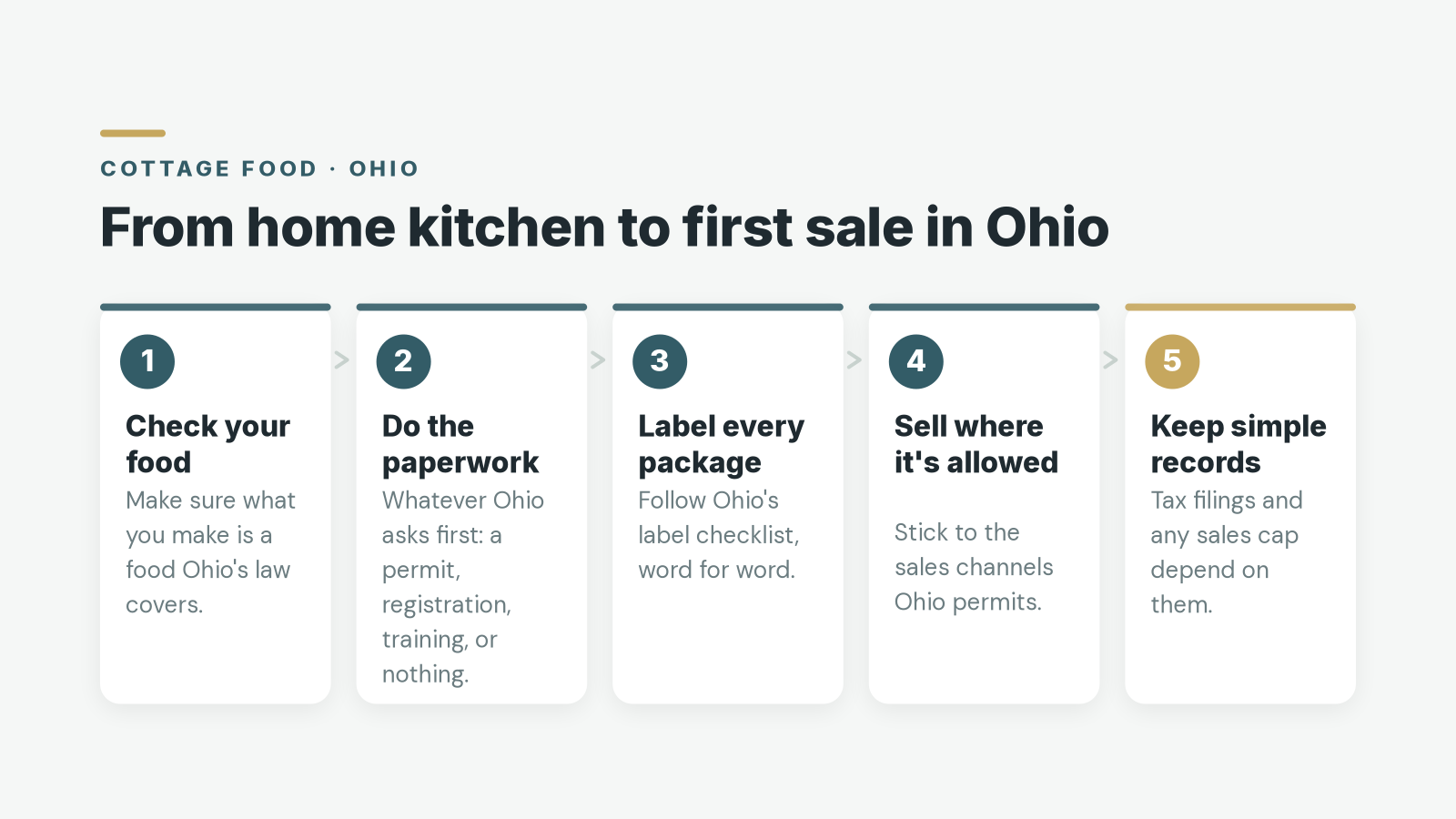
Where you can sell
Production rules and selling rules are separate questions in Ohio. Your kitchen can be legal while a particular booth still needs a license from the local health department.
| Where | Cottage food | Home bakery |
|---|---|---|
| From your home, direct to the buyer | ✅ No retail license needed (ORC 3717.22) | ✅ Yes |
| Farmers markets | ✅ No retail license needed if you sell only exempt products | Local Retail Food Establishment license needed |
| Online or phone orders, delivered or picked up in Ohio | ✅ Yes | ✅ Yes |
| Shipping to Ohio addresses | ✅ Yes | ✅ Yes, with proper cold handling |
| Stores, restaurants and coffee shops | ✅ They can sell or use your labeled products | ✅ Yes |
| Festivals | Check with the local health district | Check with the local health district |
| Shipping to another state | ❌ No | Ohio allows it; the other state's rules apply |
The out-of-state line comes straight from OAC 901:3-20-05(F): a cottage food operation may not "sell cottage food products outside the state of Ohio." Inside Ohio, OSU's cottage food bulletin says "there are no restrictions on sales that occur within Ohio," which is why online orders and local delivery fit. Nobody has published rules for third-party delivery apps specifically, so if one would store or resell your product, ask ODA first.
For home bakery products at a farmers market, OSU says you need a Retail Food Establishment license from the local health department on top of the ODA registration. The festival exemption in ORC 3717.22 only covers events run by a city, county or other public body that last seven days or less, so a private craft fair isn't automatically covered. Ask the health district that covers the event.
At markets, OSU's farmers market food safety fact sheet adds one more rule: cottage food has to be packaged where it's made, in the size you'll sell it. No slicing or bagging at the booth.
The cottage food label
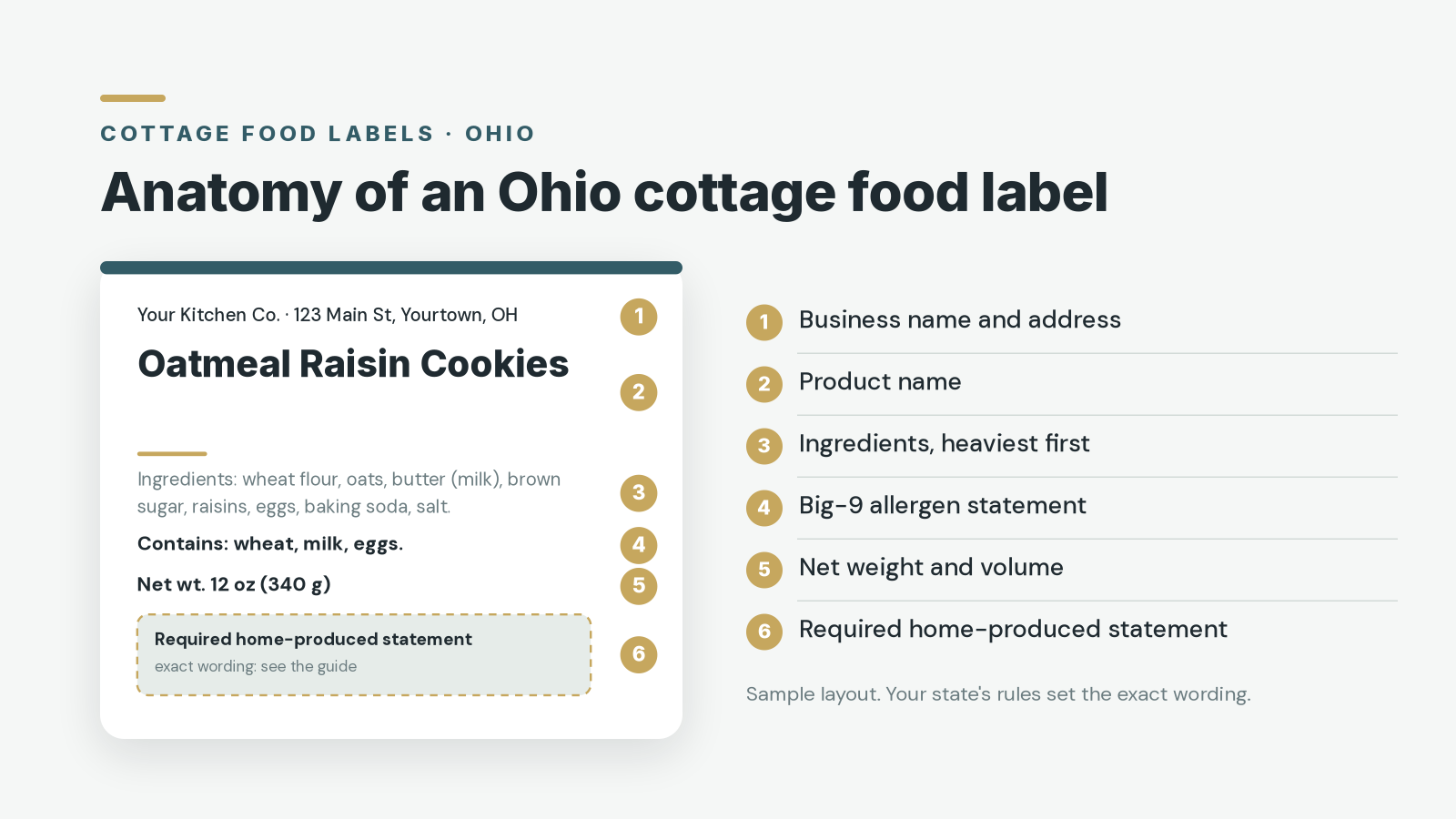
Under ORC 3715.023, every cottage food package needs:
- The name and address of your business. OSU spells out street address, city, state and ZIP code.
- The name of the product, like "Oatmeal Raisin Cookies."
- Ingredients in descending order by weight, with sub-ingredients in parentheses: "chocolate chips (sugar, chocolate liquor, cocoa butter, soy lecithin, vanilla)."
- The net weight and volume. OSU's bulletin shows U.S. weight first with metric in parentheses, placed in the bottom 30% of the label.
- This exact statement, in 10-point type:
This product is home produced.
Federal allergen labeling applies on top of that. Declare any of the nine major allergens the product contains (milk, eggs, fish, crustacean shellfish, tree nuts, peanuts, wheat, soybeans and sesame), either in the ingredient list or in a "Contains:" line right after it. Name the specific nut. A "may contain" line doesn't replace declaring what's actually in the food. If you make a claim like "low sugar," federal nutrition labeling kicks in too.
Home bakery labels need the same identity, address, quantity, ingredient and allergen information, but not the "home produced" statement. Anything that needs cold holding should say so, with something like "Keep Refrigerated."
Roasted coffee and dry goods
Ohio is one of the clearer states for home roasters. Roasted coffee, whole bean or ground, is on the cottage food list by name, so you can sell it with no license. The guide to selling home-roasted coffee covers pricing and setup, and Ohio removes the usual licensing question.
Two limits apply. OAC 901:3-20-04(B) says cottage food "may not be packed using reduced oxygen packaging," and the definition in OAC 901:3-20-01 covers removing oxygen or replacing it with another gas. So no vacuum sealing and no nitrogen flushing. The rules don't address ordinary one-way valve bags, so confirm your bag with ODA if you're unsure. And brewed coffee, cold brew and bottled tea aren't on the list, so they need a different license.
Sales tax and the vendor's license
Most of what a cottage baker sells isn't taxable in Ohio. Food sold to be eaten somewhere other than where it's bought is exempt from sales tax, and OSU's sales tax bulletin for markets lists baked goods and candy among the exempt examples.
If you only sell exempt items, you don't need a vendor's license. The Department of Taxation's 2026 small business tax guide says you don't need to register "if you only sell items that are never subject to sales tax." Add a taxable item, like a mug or a tote bag next to your coffee, and you'll need one. The fee under ORC 5739.17 is $50, through your county auditor or the state's online registration. Older pages still say $25.
Some markets ask every vendor for a vendor's license regardless. That's the market's rule, not the state's, and it's worth asking about before you apply.
Zoning and local rules
The state exemption doesn't settle whether your city allows customers at your door. OSU tells cottage food sellers to check local zoning for any limit on home-based retail sales. If you'll run a porch pickup or have regular traffic, call your city or township zoning office first. If you rent or live in an HOA, read your lease or bylaws as well. The cottage food rules don't override either one.
What could change: House Bill 134
House Bill 134 would add a third route, a "microenterprise home kitchen operation" registered with ODA. The House-passed version caps sales of potentially hazardous homemade food at $150,000 a year and lets those operations keep selling cottage food and home bakery products too. It passed the House on November 19, 2025 and went to the Senate Agriculture and Natural Resources Committee on February 11, 2026. It hasn't passed the Senate, so it isn't law. Don't rely on it until it's enacted.
What it costs to start
| Item | Cost | Required? |
|---|---|---|
| Cottage food license | $0, none exists | No |
| Home bakery registration | $10 a year | Only for home bakery products |
| Vendor's license | $50 | Only if you sell taxable items |
| Local Retail Food Establishment license | Set by your health district | Home bakery products at farmers markets |
| Labels | Your printer, or a label service | Yes |
| Well water test | Varies by lab | Home bakery, if you're on a well |
Taking orders for a weekly bake
Because Ohio allows online orders and local delivery for cottage food, the simplest setup is a weekly drop: post what you're baking, take orders during the week, and hand everything off at a set pickup time or at the market. The guide to taking preorders for baked goods walks through the logistics.
Hobby Stall is built for that kind of batch selling. You schedule a drop with pickup windows, buyers claim what you've made, and they pay you directly by Venmo or Cash App. We take 0% commission, and plans are a flat subscription with a $1 first month (card required). The details are on the pricing page, and other states' rules are in the cottage food law hub.
Official resources
| Source | What it's for | Link |
|---|---|---|
| Ohio Administrative Code 901:3-20 | Cottage food rules and the 20-category list | codes.ohio.gov |
| ORC 3715.023 | Label requirements | codes.ohio.gov |
| ORC 911.02 | Home bakery registration and fee | codes.ohio.gov |
| ODA Division of Food Safety | Questions about a product, the home bakery inspection | agri.ohio.gov |
| OSU Extension | Cottage food and home bakery bulletins | farmoffice.osu.edu |
| Ohio Department of Taxation | Vendor's license and sales tax | 2026 small business tax guide |
This post is general information, not legal advice. Confirm your products and setup with the Ohio Department of Agriculture before you start selling.
Once your labels are ready and your first bake is planned, a Hobby Stall shop can take the orders and set the pickup windows, and buyers pay you directly by Venmo or Cash App.
Frequently asked questions
- Do I need a license to sell cottage food in Ohio?
- Not for foods on Ohio's cottage food list. A cottage food production operation needs no license, registration or inspection from the Ohio Department of Agriculture, as long as every product is on the list in Ohio Administrative Code 901:3-20-04 and is labeled correctly. Foods that need refrigeration, like cheesecake or cream pies, need a home bakery registration instead.
- What is the difference between Ohio cottage food and a home bakery?
- Cottage food covers 20 listed categories of shelf-stable food, with no license and no inspection, and the products can only be sold in Ohio. A home bakery registration costs $10 a year, requires an inspection of your kitchen by the Ohio Department of Agriculture, and lets you sell baked goods that need refrigeration, such as cheesecake, cream pie, pumpkin pie and items with cream cheese frosting.
- Is there a sales cap for Ohio cottage food or home bakeries?
- No annual sales cap appears in Ohio's cottage food rules or in the home bakery registration statute (Ohio Revised Code 911.02). The $150,000 figure you may see belongs to House Bill 134, which would create a microenterprise home kitchen registration. As of November 2026 it has passed the House but not the Senate, so it is not law.
- Can I sell Ohio cottage food online or ship it?
- Within Ohio, yes. The cottage food rules forbid selling cottage food products outside Ohio, and OSU Extension reads them as placing no restriction on sales that happen inside the state. That leaves room for online orders, local delivery and shipping to Ohio addresses. Home bakery products are different: Ohio doesn't restrict out-of-state sales, but you have to meet the other state's rules.
- What has to be on an Ohio cottage food label?
- The name and address of your business, the name of the product, ingredients in descending order by weight, the net weight and volume, and the statement "This product is home produced." in 10-point type. Federal allergen labeling also applies, so declare any of the nine major allergens the product contains.
- Can I sell home-roasted coffee in Ohio?
- Yes. Roasted coffee, whole bean or ground, is one of the 20 cottage food categories, so it needs no license. Brewed coffee, cold brew and other drinks are not on the list. Cottage food can't be packed in reduced oxygen packaging, which covers vacuum packing and nitrogen flushing.
Keep reading
- California Cottage Food Law: A 2026 Guide for Home Bakers and Makers
California cottage food law lets you sell from your home kitchen with no inspection required. Learn Class A vs Class B permits, allowed foods, sales caps, and labeling rules as of June 2026.
- Colorado Cottage Food Law: 2026 Rules and the 2027 Tamale Act
Colorado's cottage food rules through 2026 ($10,000 net per product, no registration) and what the 2027 Tamale Act changes: registration, labels, $150,000 cap.
- Big Cartel vs Shopify: Cost and Caps Compared
Big Cartel is cheaper and simpler. Shopify does more and costs more. The honest split on price, product caps, drops, and local pickup.