Pennsylvania Cottage Food Law: Limited Food Establishment Guide
By Hobby Stall Team · November 24, 2026 · 10 min read
Pennsylvania doesn't have a cottage food exemption, so there's no "no license needed" option for home bakers. Instead you register your kitchen with the Pennsylvania Department of Agriculture (PDA) as a Limited Food Establishment. It costs $35 a year, it takes an inspection, and you can only make foods that don't need refrigeration. PDA states no sales cap. The catch is the lead time and the house rules: apply at least 60 days before you sell, and expect strict limits on pets. It isn't available at all in Philadelphia County.
Why Pennsylvania works differently
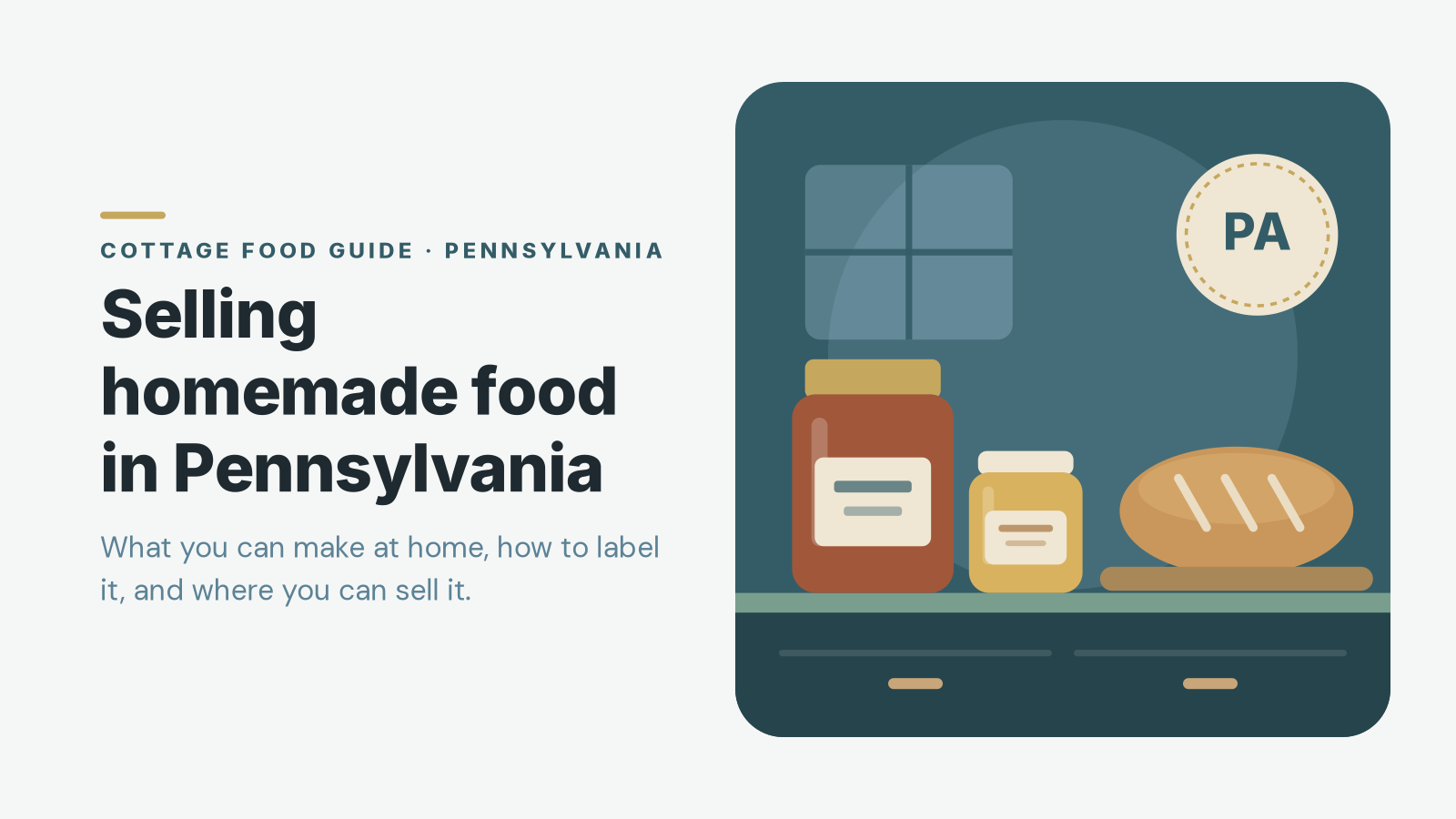
Most states exempt small home producers from food licensing. Pennsylvania's Food Safety Act (3 Pa.C.S. §§ 5721 to 5737) goes the other way. PDA's application packet quotes it directly: "it shall be the duty of every person operating a food establishment within this Commonwealth to register." A home kitchen that makes food for sale is a food establishment.
"Limited Food Establishment" is the name PDA uses for that home kitchen. Its registration page defines it as "a residential-style kitchen used to prepare non-hazardous foods that do not require refrigeration after preparation." So it works more like a light license than an exemption. Someone from PDA comes to your house before you sell anything, and registration "involves routine inspection" after that.
What you can make
Only foods that don't need time or temperature control for safety (TCS foods, in food-safety terms). The packet's examples:
| ✅ Allowed | ❌ Not allowed |
|---|---|
| Cakes, breads, cookies, muffins, brownies, biscotti | Cheesecake, pumpkin pie, custard, cream or meringue pies |
| Most fruit pies and pastries | Cream-filled pastries, pudding |
| Jams and jellies | Meat, fish, dairy and egg dishes |
| Candy | Cut fruit and vegetables, tofu, garlic in oil |
| Dry goods: cereals, coffee, tea, spices, dry herbs, dry pasta, nuts and mixes | Low-acid canned foods |
| Acidified and fermented foods with a tested pH of 4.6 or below | Freshly brewed coffee and tea |
| Dehydrated foods, after testing | Anything that needs refrigeration after it's made |
The packet says the list isn't complete and that products are "evaluated individually." If you want to sell something unusual, describe it in your application and let the inspector decide.
Lab tests you may need
Some products need a lab report before PDA will approve them. You pay for the testing, and you repeat it when a recipe changes. The packet lists:
| Product | Test |
|---|---|
| Acid, acidified or fermented foods and drinks | pH |
| Dressings, sauces and salsa | pH and water activity |
| "Moist" breads and cakes, and some pies | Water activity and pH |
| Dehydrated foods | pH and water activity |
| Anything the inspector questions | pH and water activity |
Water activity measures how much free water a food has for bacteria to use. A zucchini bread or a very moist cake can need testing even though it looks like an ordinary bake. No testing is required for most candy.
The kitchen rules
These are where most home kitchens run into trouble, so read them before you fill anything out.
- Pets. "No animals/pets are permitted in the home at any time if the personal home kitchen is used." The only way around it is a processing and storage area that's physically separated by a fully closing door (baby gates don't count) and has its own entrance and exit. Fish, caged reptiles and caged hamsters aren't "pets" for this rule if they're kept away from the kitchen. Dogs, cats, birds and rabbits are.
- Children. Kids aren't allowed in the kitchen while you're processing food for the business.
- No overlap. You can't cook for your family and bake for the business at the same time. PDA calls it a "dual-use" kitchen and expects you to schedule around it.
- Water. On public water, you show a water bill. On a private well, you need an initial test for total coliform and for nitrate/nitrite at a DEP-approved lab, then a coliform test every year.
- Sewage. If you're on an on-lot septic system, contact your municipality's Sewage Enforcement Officer.
PDA's packet doesn't name a required food safety course, but it says operators and employees must "demonstrate basic food safety knowledge." Expect the inspector to ask.
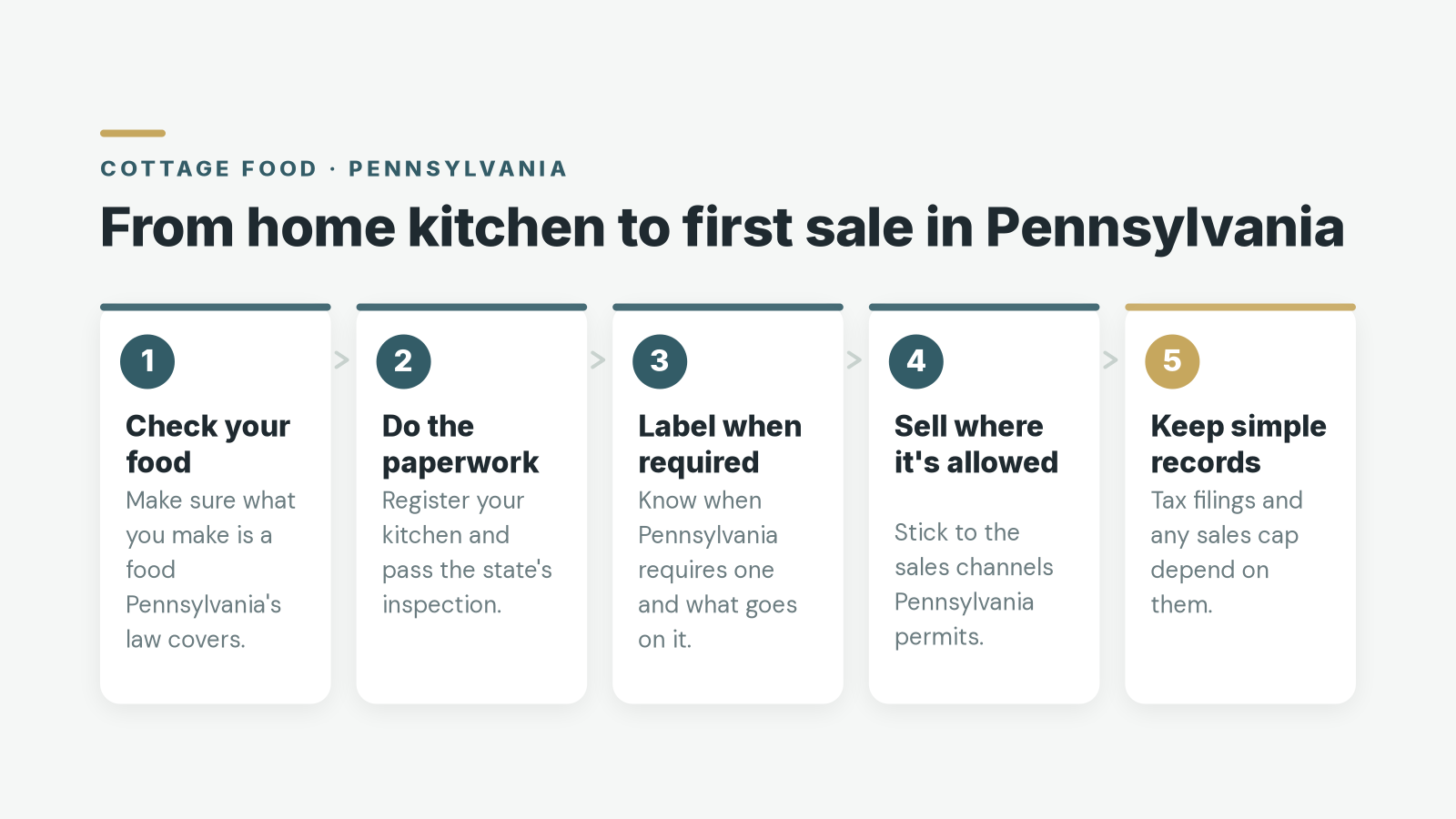
How to register, step by step
- Check zoning first. The application asks you to contact your township, borough or city office and confirm that a food business is allowed at your address, with the date you checked. PDA says its approval "does not imply" you meet local zoning.
- Check whether your county runs its own health department. Allegheny, Bucks, Chester, Delaware, Erie, Montgomery and Philadelphia counties do, according to PDA. In those counties, the packet says county licenses or registrations come before PDA's.
- Put the packet together. It includes the application, a written business plan (suppliers, storage, equipment, how you'll make and transport the food, and every address you'll sell from), your labels, any lab results, proof of your water supply, and a sales tax license or a signed statement that your products are exempt.
- Submit it at least 60 days before you plan to sell. Email is preferred (ra-agplanreview@pa.gov). Don't send money with the application.
- Wait for a decision. PDA says it reviews plans "within 15 business days" and emails an approval letter.
- Pass the opening inspection. The inspector collects the $35 fee (check or money order made payable to the Commonwealth of Pennsylvania) and leaves an inspection report that works as temporary proof of registration until the certificate arrives.
- Renew every year. Renewal is $35 and can be paid online.
Sixty days is the number to plan around. If you want to sell at spring markets, apply in winter.
Philadelphia and the county health departments
The packet is blunt about Philadelphia: "A Limited Food Establishment registration is NOT permitted in Philadelphia County." Selling food there as a home producer means NSF/ANSI-certified equipment in a commercially zoned property, which isn't a home kitchen anymore. If you're in Philadelphia, a shared commercial kitchen is the realistic route.
In the other six county health department areas (Allegheny, Bucks, Chester, Delaware, Erie and Montgomery), expect a county step in addition to PDA. Some municipalities also license food businesses themselves, so ask your local office.
Where you can sell
PDA's FAQ says that once registered, "you may sell at farmers markets, community events, roadside stands, and directly to consumers."
| Where | Allowed? |
|---|---|
| From your home, including online orders | ✅ Registration "includes sales direct from the production site including internet sales" |
| Farmers markets | ✅ Yes, and a Retail Food License may also be required |
| Community events and roadside stands | ✅ Yes, and an event license may also be required |
| Retail stores carrying your products | ✅ Some, if your labels meet the requirements |
| Restaurants and wholesale | ❌ PDA's FAQ says "direct-to-consumer sales only" |
| Shipping to another state | Possible, but you may also need FDA registration |
Two notes on that table. At events and markets, PDA says a Retail Food Facility License "may also be required." PDA's farmers market page says each stand needs its own license. Whether yours does depends on what you sell and where, so ask the market manager and the health department that covers the market. If the market is in one of the seven county health department areas, the county may issue its own event or seasonal permit.
On wholesale, PDA's own documents aren't consistent. The FAQ says no, while the application form has checkboxes for wholesale sales. If a coffee shop or store wants to carry your product, get PDA's answer in writing before you agree.
The label
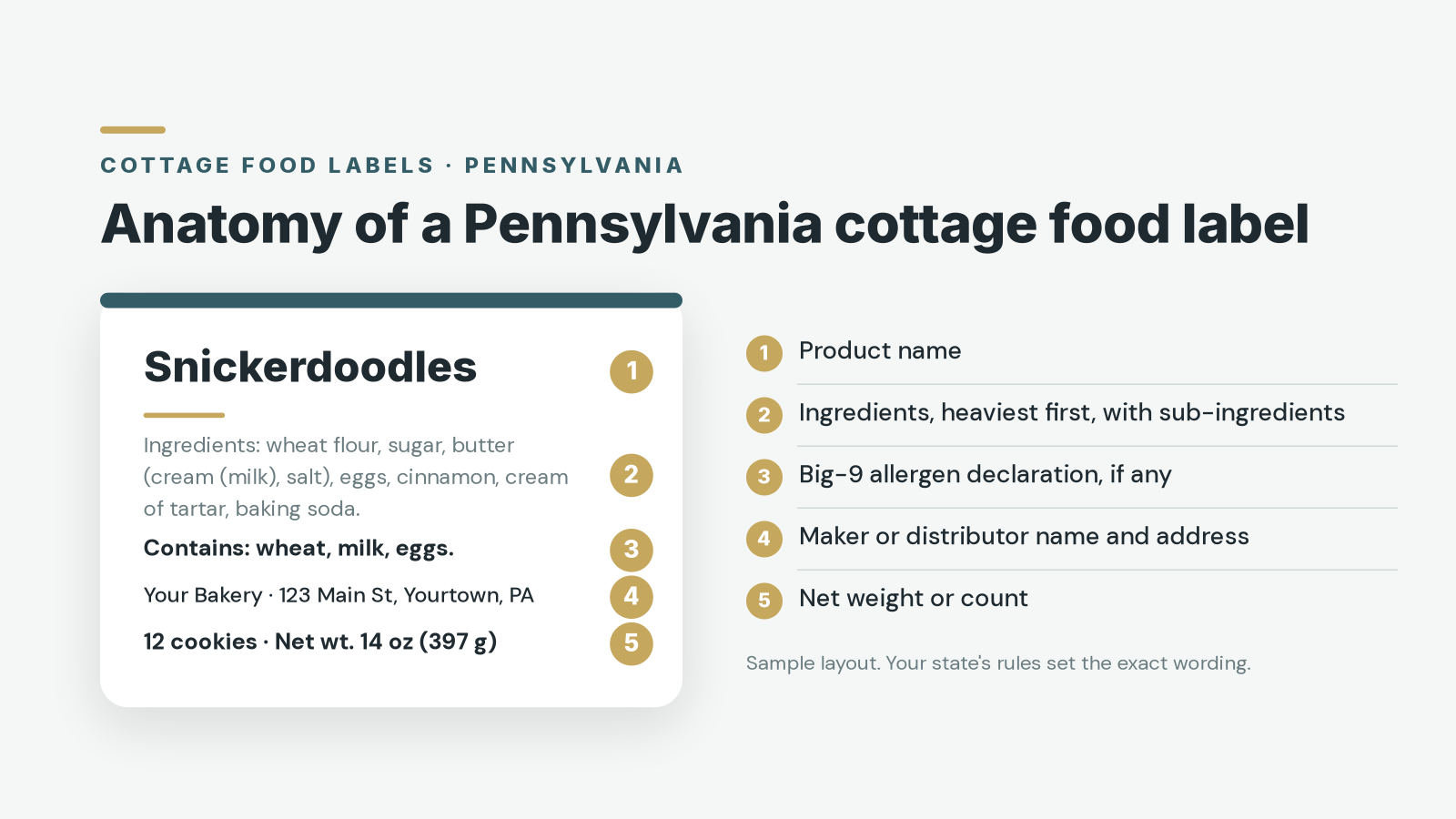
PDA's packet lists five elements for packaged products:
- The name of the product
- Ingredients, listed from most to least by weight, including sub-ingredients
- An allergen declaration, if the product contains a major allergen (the federal list is milk, eggs, fish, crustacean shellfish, tree nuts, peanuts, wheat, soybeans and sesame)
- The name and address of the manufacturer or distributor
- Net weight or count, on the bottom third of the main panel, in type no smaller than 8 point
Pennsylvania has no required "made in a home kitchen" sentence, which is different from most cottage food states. Claims like "gluten free," "dairy free" or "sugar free" have to be backed up and can trigger a Nutrition Facts panel.
One exception helps bakers a lot. Baked goods you make and sell directly to a Pennsylvania customer, at your kitchen or at a satellite location like a farmers market, "do not require any labeling information directly on the products." You do have to give ingredient information to anyone who asks. Baked goods sold through a store you don't own need the full label.
Roasted coffee and dry goods
The application packet lists "coffee/tea" under dry goods, alongside spices, dry herbs, dry pasta and nuts. That means home-roasted beans, whole or ground, go through the same Limited Food Establishment registration as everything else. The guide to selling home-roasted coffee covers pricing and packaging.
PDA hasn't published rules specific to home roasting (ventilation, chaff or smoke). Mention your roaster and where it sits in your business plan so the inspector sees it up front. Brewed coffee and tea are a different story. The packet says they're TCS foods "due to their high pH (>4.6)," so you can't make them in a home kitchen.
Sales tax
Most home-baked food isn't taxable in Pennsylvania. The Department of Revenue's taxability list says that for food sold from a farmers market, bakery and similar places, tax "is not imposed" generally, with listed exceptions. Whole or ground coffee beans, candy and caramel corn are marked not taxable. Hot brewed coffee is taxable.
The PDA application asks you to either attach a sales tax license or state that your products are exempt. If you sell anything taxable, you need the license. The state's Business One-Stop Shop says there's no fee, and you apply online through myPATH. Selling food to eat on the spot at an event can change the answer, so ask Revenue if that's your plan.
What could change: House Bill 2750
House Bill 2750 would create a "microenterprise home kitchen operation" under Pennsylvania's food law, a separate license meant to widen what home cooks can sell. It was referred to the House Agriculture and Rural Affairs Committee on August 27, 2026 and hasn't had a vote. It isn't law, so don't plan around it until it passes.
What it costs to start
| Item | Cost | Required? |
|---|---|---|
| Limited Food Establishment registration | $35, then $35 a year | Yes |
| Sales tax license | $0 | If you sell anything taxable |
| Lab testing (pH, water activity) | Varies by lab | For some products |
| Private well tests | Varies by lab | If you're on a well |
| Retail Food License or event permit | Set by the licensing agency | Sometimes, at markets and events |
| Labels | Your printer, or a label service | For packaged products |
Taking orders once you're registered
Because PDA's registration covers internet sales from your kitchen, a weekly preorder setup fits well: post the week's bake, take orders, and hand them off at a pickup time or at the market. The guide to taking preorders for baked goods covers the logistics.
Hobby Stall is built for that. You schedule a drop with pickup windows, buyers claim what you've made, and they pay you directly by Venmo or Cash App. We take 0% commission, and plans are a flat subscription with a $1 first month (card required). The details are on the pricing page, and other states' rules are in the cottage food law hub.
Official resources
| Source | What it's for | Link |
|---|---|---|
| PDA Limited Food Establishment page | Fees, steps, FAQ | pa.gov |
| PDA application packet | The application, kitchen rules, labels, testing | Application packet (PDF) |
| PDA farmers markets | Retail Food License for market stands | pa.gov |
| PDA food safety contacts | County health departments and regional offices | pa.gov |
| Department of Revenue | What's taxable | Taxability list |
| Penn State Extension | Regulations for food processors | extension.psu.edu |
This post is general information, not legal advice. Confirm your products, your county's rules and current fees with the Pennsylvania Department of Agriculture before you apply.
Once you're registered and your first bake is planned, a Hobby Stall shop can take the preorders and set the pickup windows, and buyers pay you directly by Venmo or Cash App.
Frequently asked questions
- Does Pennsylvania have a cottage food law?
- No. Pennsylvania has no cottage food exemption. Anyone who makes food at home to sell has to register the kitchen with the Pennsylvania Department of Agriculture as a Limited Food Establishment and pass an inspection. The duty to register comes from the state Food Safety Act, 3 Pa.C.S. sections 5721 to 5737.
- How much does a Limited Food Establishment registration cost?
- The initial registration fee is $35 and the annual renewal is $35. You pay the first fee by check or money order to the inspector at your opening inspection, not with the application. Lab tests, water tests and labels are extra costs you cover yourself.
- Is there a sales cap for a Pennsylvania home bakery?
- The Department of Agriculture's Limited Food Establishment page and application packet don't state any annual sales cap. The real limits are on what you can make (only foods that don't need refrigeration) and how you sell it. The department's FAQ says Limited Food Establishments are for direct-to-consumer sales, not wholesale.
- Can I sell home baked goods in Philadelphia?
- Not as a Limited Food Establishment. The Department of Agriculture's application packet says the registration is not permitted in Philadelphia County. Selling food made in Philadelphia requires NSF/ANSI equipment in a commercially zoned property.
- Can I have pets and still register my home kitchen in Pennsylvania?
- Only in a narrow case. The packet says no animals or pets are permitted in the home at any time if the personal home kitchen is used. The exception is a processing and storage area separated by a fully closing door, with its own entrance and exit. Fish and caged reptiles or hamsters don't count as pets if they're kept away from the kitchen.
- Can I sell home-roasted coffee in Pennsylvania?
- Yes, as a registered Limited Food Establishment. The application packet lists coffee and tea under dry goods. Freshly brewed coffee and tea are not allowed because their pH makes them foods that need temperature control. Whole or ground coffee beans are generally not subject to Pennsylvania sales tax when sold from a bakery or farmers market.
Keep reading
- Ohio Cottage Food Law 2026: Cottage Food vs Home Bakery License
Ohio lets you sell 20 kinds of cottage food with no license, and more with a $10 home bakery registration. Allowed foods, label wording and where to sell.
- California Cottage Food Law: A 2026 Guide for Home Bakers and Makers
California cottage food law lets you sell from your home kitchen with no inspection required. Learn Class A vs Class B permits, allowed foods, sales caps, and labeling rules as of June 2026.
- Big Cartel vs Shopify: Cost and Caps Compared
Big Cartel is cheaper and simpler. Shopify does more and costs more. The honest split on price, product caps, drops, and local pickup.